
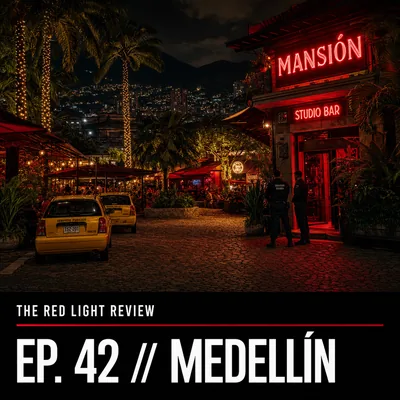
Bogotá & Medellín — La Candelaria, Parque Lleras, Prepago Culture
La Candelaria, Parque Lleras, and prepago culture
This episode hasn't been released yet. Subscribe to be notified when it drops.
It is eleven o'clock on a Saturday night in El Poblado, Medellín's wealthiest commune, and the rain has just broken. Steam rises from the cobblestones surrounding Parque Lleras — a small, stair-filled square no bigger than half a city block, ringed by the kind of restaurants and bars that exist in perfect replica across every aspirational Latin American city: mojitos, ceviche, Spotify playlists, rooftop terraces with string lights. By day it is a neighborhood park.
By night, for perhaps the past decade, it has been something else entirely: the most concentrated open-air sexual marketplace in South America below Copacabana, a place where supply and demand for paid sex meet under police spotlights and the philosophical indifference of a city that has been trying to change its image since Pablo Escobar bled out on a rooftop in December 1993.
Tonight, a young woman named Alexa — not her real name, she'll tell an El País journalist two years from now in a piece that earns her face a story — is standing on Calle 10 in El Poblado in a skimpy black dress. Around her, perhaps 200 women shelter under café awnings. Some are in their late twenties, broad-shouldered, from Cali.
Some are Venezuelan, impossibly young-looking, desperate in the way that a human being who has been pushed by economic catastrophe across a border and deposited in a city that doesn't want her can look desperate while wearing a short skirt and smiling.
Some are unmistakably minors — a fact visible to anyone who cares to look, which this evening, for the most part, nobody official does.
The foreigners move through the crowd with a particular gait. There are Americans in board shorts, Europeans in linen shirts gone limp in the humidity, a few Israeli backpackers, a scattering of Australians. They have all read the same forum posts. They know the market.
The going rate for an hour with an adult woman in Parque Lleras is roughly $50 to $120 USD — sometimes higher if she speaks English or has an Instagram portfolio that suggests exclusivity, sometimes lower for the Venezuelan migrants clustered in the streets just outside the park's low iron fence.
The system of advance payment — prepago, from pago adelantado, payment in advance — defines the transaction: money transferred via Nequi or paid in cash to a WhatsApp coordinator before the woman arrives at the hotel door.
Alexa manages forty women this way from a WhatsApp group she has named "Bichotas," a tribute to Karol G, Colombia's biggest pop star, herself a Medellín native.
This is the machine. It is enormous, it is organized, and it is, at the very moment of this writing, under assault from a mayor, an outraged national government, a foreign embassy, and an international press corps — while simultaneously thriving in every direction the cameras don't point.
To understand Medellín's sexual economy in 2024, you must understand what the city escaped and what it never fully escaped.
In 1991, at the peak of Pablo Escobar's influence over the Medellín Cartel, the city's homicide rate reached 375 murders per 100,000 residents annually — three times higher than what was then the most dangerous city in the world, Caracas, Venezuela, by equivalent measure.
Escobar's cartel controlled an estimated 80 percent of the global cocaine market and generated approximately $70 million per day at the height of its power in the mid-1980s.
The violence was not incidental but structural: judges, presidential candidates, journalists, police officers, and ordinary citizens were assassinated in coordinated campaigns designed to make the Colombian state ungovernable unless it accommodated Escobar's terms. Three Colombian presidential candidates were killed in the election cycle of 1989-1990.
The Colombian Palace of Justice had been seized and burned by M-19 guerrillas in 1985, a trauma the country never forgot.

Comments