
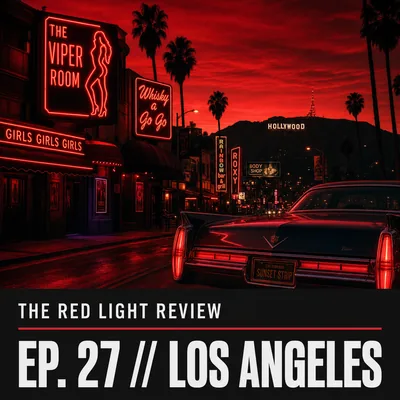
Los Angeles — Hollywood Escort Scene, Sunset Strip, Modern LA
The Hollywood escort scene, Sunset Strip, and modern LA
This episode hasn't been released yet. Subscribe to be notified when it drops.
It is a Tuesday in February, just cold enough to feel foreign in Los Angeles. On Sunset Boulevard, between La Cienega and Crescent Heights, the sidewalk smells of cigarettes, jasmine cologne, and the faint diesel exhaust of an idling black Escalade. Three women in platform heels navigate a cracked sidewalk outside Bar Marmont, the annex bar of the Chateau Marmont. One of them checks her phone. She is not waiting for a Lyft.
A hundred and sixty feet above Sunset, in a bungalow that the hotel rents for roughly $900 a night, a music-industry executive is on his third whiskey and his second text thread. The first thread is his assistant. The second is a number attached to no name in his contacts, just an area code: 213.
What happens next—how money moves, who gets a cut, how the encounter is structured and priced and legally insulated—is the story of Los Angeles's commercial sex economy, which is layered, geographic, racially stratified, and worth, by the most careful estimates available, somewhere between $500 million and $1.5 billion annually in the nation's second-largest city. That is a deliberately wide band. Los Angeles doesn't make this easy to count.
This episode covers the full geography: the Sunset Strip's post-Heidi Fleiss escort market; the Korean-run erogenous zone running along Western and Olympic in Koreatown; the Latino brothel networks operating out of East LA, Maywood, and Cudahy; the adult-film industrial complex in Chatsworth and Northridge; the strip clubs from Crazy Girls to Spearmint Rhino; the FOSTA-SESTA fallout; and the enforcement apparatus—LAPD's Human Trafficking Task Force, FBI Operation Cross Country, Polaris hotline data—that circles all of it without ever quite closing the loop.
We begin, as all good LA stories do, in the past.
Los Angeles County covers 4,751 square miles and contains 88 incorporated cities. That sprawl is not incidental to understanding its commercial sex economy—it is the economy's structural precondition. Zoning enforcement that might be tight in a dense city becomes porous across dozens of separate municipal jurisdictions.
A massage parlor in the City of Bell can operate under different rules than one in the City of Los Angeles, two miles to the north. Law enforcement agencies—LAPD, the LA County Sheriff's Department, municipal police forces in Compton, Gardena, and two dozen other cities—coordinate imperfectly. Vice officers get reassigned. Political priorities shift.
The result is a market that operates in niches: the luxury escort tier anchored to the Sunset Strip hotels and the Beverly Hills hotel corridor; the Korean-immigrant massage economy running along a precise set of streets in Koreatown and its satellite communities; the Latino short-time brothel network operating in converted motels and private homes east of the Los Angeles River; and the adult-film production apparatus, which operates entirely semi-legally in the San Fernando Valley, generating legal product that both feeds and is fed by the demand for the commercial sex services that surround it.
Los Angeles became the center of American adult-film production for reasons that were initially practical and became self-reinforcing.
By the early 1970s, the mainstream film industry's infrastructure—cameras, editing equipment, makeup artists, set builders, lighting technicians, and an enormous pool of performers willing to work non-union—was concentrated in the greater Los Angeles area. " Paul Fishbein, co-founder of adult trade group AVN Media Network, confirmed as much to the Associated Press in 2002.



Comments