
Phnom Penh & Sihanoukville — Cambodian Bar Scene, Chinese Influx
The Cambodian bar scene and the Chinese capital influx
This episode hasn't been released yet. Subscribe to be notified when it drops.
The motorbike drops you on Sisowath Quay just before eleven. The Mekong is invisible to your right—swallowed by darkness beyond the seawall—but you can hear the brown water purling against the embankment. The boulevard in front of you is lit amber and neon, the air soaked in generator exhaust, frangipani, and something meaty char-grilling somewhere upwind. A row of tuk-tuk drivers lean on their handlebars, dead-eyed, waiting.
You are about forty meters from Street 104—a single block that, in the span of a hundred-meter walk, offers you perhaps four hundred bars. That number is not hyperbole.
As recently as September 2023, a correspondent who had covered the scene since 2019 counted roughly that many venues—nearly identical in format, open-fronted, fluorescent-lit, each with a row of high stools, a pool table, and a cluster of hostesses in matching tank tops—crammed between Streets 104 and 154 along the riverfront grid.
The supply so vastly exceeds the demand that by midnight on an average weekend, most of those bars contain fewer than a dozen customers. The girls scroll their phones, eat from takeaway boxes, shout half-heartedly at passing men.
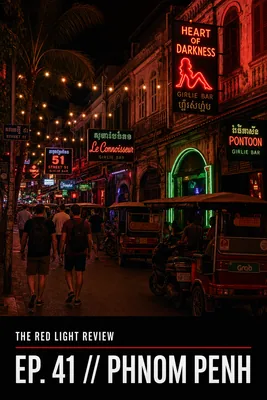
Walk two blocks west and a little south and you hit Street 51—Rue Pasteur to the old-timers who arrived when the French colonial architecture was the city's skeleton. The street runs straight and wide past shophouses and restaurants.
About halfway along stands a sign that has been illuminated, switched off, illuminated again, and switched off again over three decades: Heart of Darkness. The bar opened in 1993, making it one of the longest-running nightlife brands in Southeast Asia.
For two decades it was the gravitational center of Phnom Penh's Western expat and sex-tourist scene: a labyrinthine Khmer-baroque interior of dark wood, stone carvings, and thumping hip-hop where Cambodian women circulated freely and nobody asked too many questions.
It closed during one of the city's downturns, reopened, closed again—and as of 2025 has reopened again with drag shows on Fridays and Saturdays and a TripAdvisor rating of four stars. In Phnom Penh, nothing dies entirely.
Tonight, however, there is something new. On the opposite end of town, in the Boeung Keng Kang district, a different kind of nightlife is operating. Inside the compound of NagaWorld Hotel and Casino—Cambodia's only Phnom Penh casino—a hostess bar called Darlin' Darlin' is full. The crowd is almost entirely Asian: Japanese, Korean, Singaporean, and Cambodian Chinese.
The price of a lady drink is $15. The bar fine runs to $50 or more. These are not the backpackers on fifty-dollar-a-day budgets who once defined the riverside scene. These are men with capital and they are here because Phnom Penh, in the decade since Chinese investment began flooding into Cambodia, has been rewritten for them.
This is the story of that rewriting—and of everything it buried.
To understand Phnom Penh's sex economy you must first understand its annihilation. The Khmer Rouge, under Pol Pot, seized the capital in April 1975. 7 to 2 million people—roughly a quarter of the population—perished from execution, forced labor, starvation, and disease. Commercial sex, categorized as "immoral activity" (khos sel'thor), was banned and punishable by death.
The state attempted, with considerable brutality, to eliminate the sex trade entirely. It largely succeeded.
When the Vietnamese-backed People's Republic of Kampuchea came to power after ousting the Khmer Rouge in January 1979, the country had to reconstruct itself from the ruins of one of the twentieth century's most catastrophic experiments in social engineering. A generation of educated Cambodians was dead. Institutional memory had been systematically destroyed. Poverty was extreme.


Comments