The Hosts
A reporter and a historian.
One has been working the bars of Bangkok, Manila, and Kabukichō since 2021. The other has spent fifteen years reading court records and brothel ledgers in five languages. They have been arguing about this beat for years over late-night drinks, and now they argue on a podcast.
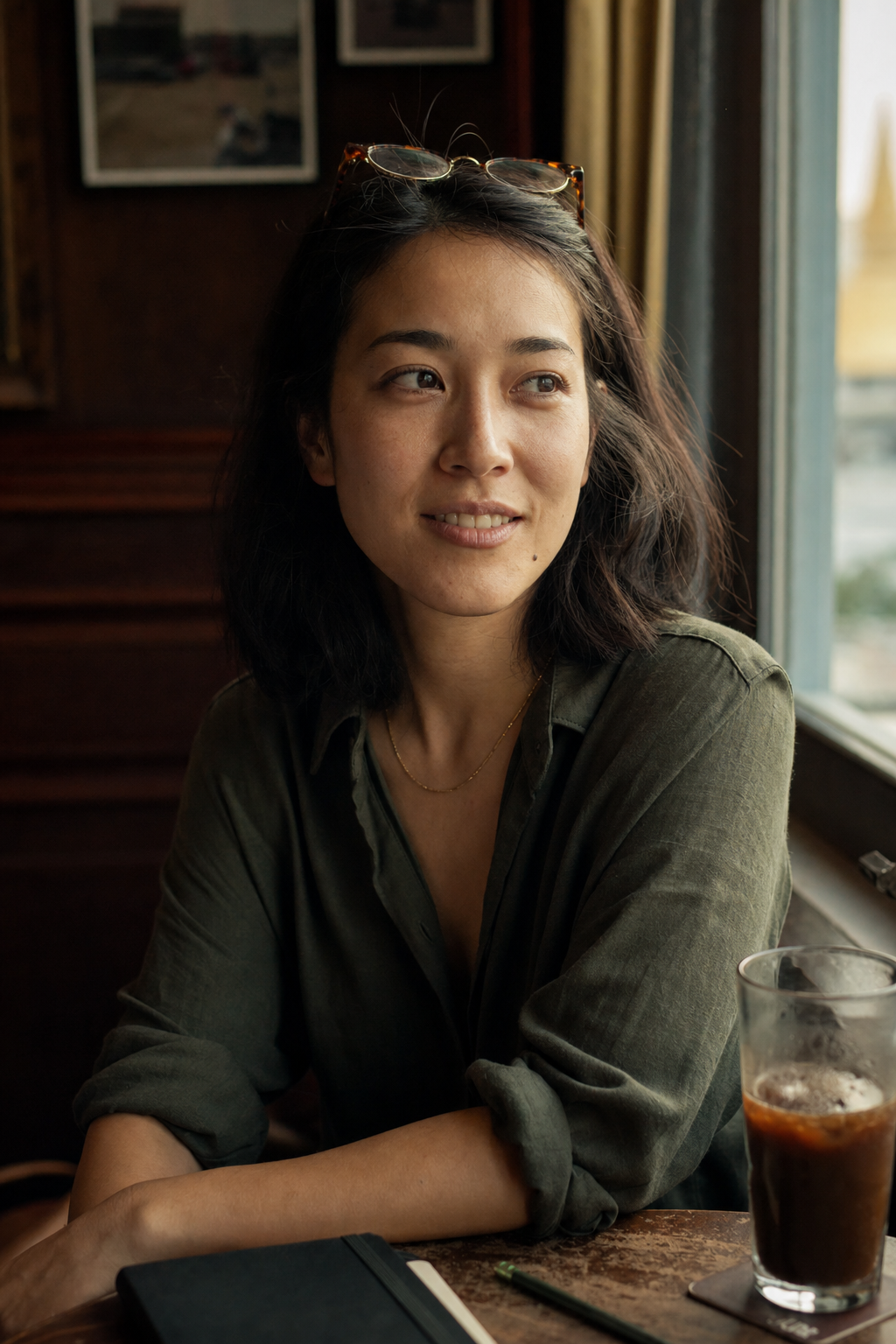
On-the-ground reporter
Maren Saito
Bangkok
“Reporters from the New York office land at Suvarnabhumi, file a piece about the bar girls of Soi Cowboy in twelve hours, and fly home before sunrise. I stayed. The story is not in the bar. The story is the bar fine, who collects it, and where the money sleeps that night.”
Maren Saito reports the modern sex economies of Southeast Asia and Japan. Half-Japanese, half-American, raised between Yokohama and Portland, she moved to Bangkok in 2021 and has been working the same set of streets, hotels, bar-owner offices, and police precincts ever since.
Her bylines include Vice, Roads & Kingdoms, Rest of World, Mekong Review, and the late Topic. She speaks Japanese, Thai, and a workable amount of Filipino Tagalog. She has the cell number of the manager at three different soapland houses in Tokyo and is on a first-name basis with at least one retired Hamburg madam.
On The Red Light Review she takes the lead on contemporary scenes — the Bangkok bar economics, the Patpong door fees, the Manila bar-fine system, the Reeperbahn licensing fight, the OnlyFans economy of 2026. When her co-host quotes an 1897 Storyville Blue Book, she translates the price into 2026 baht.

Archival researcher
James Hollander
Bristol
“People think the historical record is silent on the brothels. It is the opposite problem. The clerks of every century wrote everything down. The bishops, the prefects, the tax collectors, the police inspectors, the madams themselves. You just have to be willing to read the footnotes.”
James Hollander — Jim to anyone who knows him — is the show's archival researcher. Brooklyn-born, Oxford-trained, he was for nine years a research fellow at All Souls before a long-form essay on the maisons closes of Belle Époque Paris ran in the London Review of Books and changed the course of his career.
He left academia in 2019 and now operates out of a converted Georgian terrace in Bristol stacked with photocopies from the Bibliothèque nationale, the New Orleans Historic Collection, the Met's restricted-access print archive, and a private library on Edo Yoshiwara that has not yet been digitized. He reads French, Italian, Latin, and German; he gets by in Japanese with help. His first book, The Sporting House Ledger (Yale University Press), is forthcoming in 2027.
On the show he takes the lead on historical material — Pompeii pricing, the medieval stews, Edo Yoshiwara, Storyville, Weimar Berlin, Marthe Richard's 1946 closure of the French brothels. When his co-host names a bar fine in Pattaya, he converts it to denarii and pesos and reads a 1908 parliamentary report on the same trade in Marseille.
