
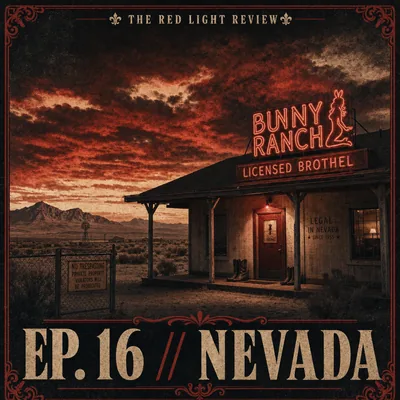
Las Vegas & Nevada Brothels — Why Vegas Is Illegal but 60 Miles Away Is Legal
Mustang Ranch, Moonlite BunnyRanch, and Nevada's licensed brothel system
This episode hasn't been released yet. Subscribe to be notified when it drops.
It is 2:17 in the morning, February 1999. A federal marshal is driving east on Interstate 80 from Reno, crossing the Truckee River into Storey County, a sliver of Nevada desert that has become the most improbable legal jurisdiction in American history. He pulls up to a gate made of wrought iron painted a shade that realtors would call terracotta and normal people call pink. A sign above reads Mustang Ranch.
Behind that gate: 166 acres of fenced compound, 54 bedrooms, a pink stucco exterior best described as a cross between a Holiday Inn and a hacienda. Technically, at this precise moment, the compound is the property of the United States Bureau of Land Management, successor to the IRS, which had seized it three years prior as payment against a $13 million tax debt. The IRS had tried to operate it.
Storey County commissioners — in a move that belongs in a case study in administrative creativity — had rezoned the brothel's land to outlaw prostitution the moment the IRS trustee tried to apply for a brothel license, forcing a distress sale. 49 million, turned out to be the personal attorney's brother of Joe Conforte, the brothel's own founder, who was by then enjoying early retirement near Ipanema Beach in Rio de Janeiro, just beyond the reach of American extradition.
The United States government had briefly been, and failed to be, a brothel operator. That absurdity captures something essential about Nevada's prostitution system: it has been, since 1971, the only legal commercial sex-work industry in the United States, and it has been, from the very beginning, a monument to the gap between American law and American behavior.
Nevada is the only state in the United States where prostitution is legally permitted in any form. S. territory — the sale of sex is a criminal offense at some level of the law.
In Nevada, since 1971, licensed brothel prostitution is not only legal but formally regulated, subject to mandatory health testing, mandatory condom use, county sheriff registration, and routine state inspection. " That phrase — "except in a licensed house of prostitution" — is the most significant exception clause in American vice law.
The system is not statewide. Nevada has seventeen counties. As of 2024, ten of those counties legally permit licensed brothels, but only six contain brothels that are currently operating. The other seven counties — including the two most populated — have banned brothels by state statute or local ordinance. Prostitution in Nevada, Wikipedia
The two largest population centers, Clark County (Las Vegas) and Washoe County (Reno), are explicitly prohibited. For Clark County, the prohibition is mandated by state law: Nevada statute bars any county with a population above 700,000 from licensing brothels. 2 million. The 700,000 threshold was not chosen arbitrarily. It was engineered.
The original 1971 law set the threshold at 200,000, which at that time covered precisely one Nevada county: Clark. When subsequent population growth pushed Clark's numbers higher, the legislature adjusted the cap upward to keep Clark perpetually ineligible — most recently raising the threshold to 700,000 in 2011.
Washoe County's ban is a separate matter: Washoe has a population around 480,000, which technically falls beneath the state threshold, but the county has imposed its own local ordinance prohibiting brothels. So has Carson City, Nevada's independent capital city.






Comments