
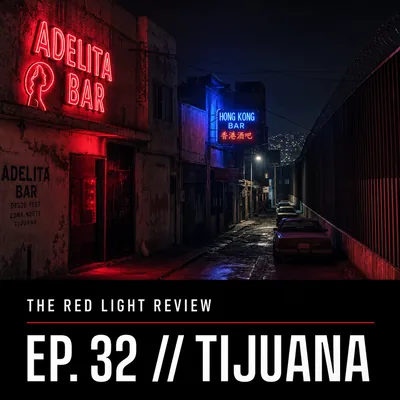
Tijuana & Mexican Border Towns — Zona Norte, Hong Kong Bar, Cartel Involvement
Zona Norte, the Hong Kong Bar, and cartel-controlled border vice
This episode hasn't been released yet. Subscribe to be notified when it drops.
Eleven o'clock on a Thursday night, and Callejón Coahuila — the 140-meter alley that splits the Zona Norte like a wound — is running at full throttle. The alley is bounded by Calle Primera to the south and Calle Coahuila to the north, by Constitución Avenue to the east and Niños Héroes to the west. It smells of rain-wet concrete, grease from the nameless taco cart on the corner, and something sharper underneath — desperation and cheap cologne layered over cheap sex.
The women stand in pairs and alone, hip-cocked against the tile walls outside the Eduardo Hotel, the As Negro cantina, and the rusted gate of a cuartería whose rooms rent for $5 a half-hour. They are the paraditas — the ones who stand — and tonight there might be eighty or a hundred of them visible in this single block alone.
Some wear platform heels that sink into the pocked sidewalk. Some have children they have left in rooms at the back of buildings on Calle Segunda. A few are no more than sixteen.
Across the alley, the Hong Kong Gentlemen's Club blazes pink and gold. A doorman in a black shirt works the velvet rope, eyeing you, doing the calculation. Inside, a hundred women in the upstairs corridors. Drinks for a girl: $9 a glass. A bucket: $90.
Sex upstairs in one of the shared-wall rooms of Hotel Cascadas, which abuts the club: $18 for 30 minutes, $100 for the full hour. Premium girls — the surgically enhanced, the photogenic — negotiate for $120 or $150 before they take your hand and lead you to the elevator.
Two blocks north, the San Ysidro border crossing processes 70,000 northbound vehicles a day. You could walk there in four minutes. You could walk there carrying anything. That is the whole point. The Zona Norte is not merely a red-light district. It is the velvet sleeve around the needle of one of the most consequential trafficking corridors in the Western Hemisphere — and it has been that way, in different shapes, for more than a hundred years.
This episode follows the money, the bodies, and the blood.
Tijuana was officially founded in 1889, but it remained a dusty settlement of under a thousand people until the United States made it a boom town — against its will, from a distance, and without intending to.
The Volstead Act of 1919 closed American saloons and banned American liquor. What it could not close was American thirst. Tijuana sat 15 miles south of San Diego, reachable in an afternoon by car or rail. Within months of Prohibition taking effect, the town's cantinas were doing the business that California's bars could not.
Racetrack betting, casino gaming, prostitution, imported European wines — all of it ran openly and without interference, because it was legal under Mexican law and adjacent to the largest consumer population in the most thirsty country on earth.
By the late 1920s, the Agua Caliente casino and resort complex — backed substantially by American investors — had become what one Los Angeles Times reporter in 1929 called a rival to Monte Carlo.
It covered 655 acres, operated a horse-racing track, featured an Art Deco ballroom, and put Hollywood stars like Charlie Chaplin, Clark Gable, and a teenage dancer named Margarita Cansino — later Rita Hayworth — on its guest lists. Architectural Digest gave it 16 pages in 1929.
What happened in Tijuana would eventually inspire Las Vegas, its more successful and longer-lived inheritor.
The architecture of vice had already embedded itself in the streets west of the tourist drag, in the nascent Zona Norte, where women had been available to American servicemen since before the casino was built. When the moral emergency ended — Prohibition repealed in 1933, Mexican casinos outlawed in 1935 — the physical infrastructure of the sex trade was already in place. It never closed. It simply descended to a lower register.




Comments