
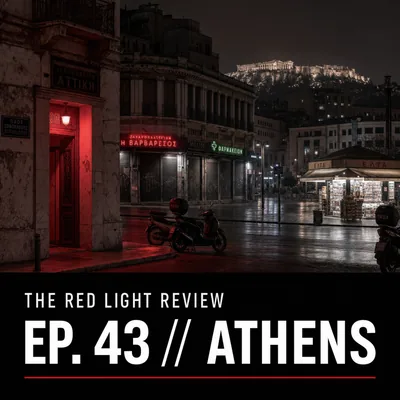
Athens & Greece — Licensed Houses, the Regulation Model
Licensed houses and the Greek regulation model
This episode hasn't been released yet. Subscribe to be notified when it drops.
The light is on. That is the first thing you learn. A single unshaded bulb above a ground-floor door in a narrow alley running off Fylis Street, burning at two in the afternoon even in full summer sun. The light means open.
In this part of central Athens — a rectangle of crumbling neoclassical apartment buildings south of Omonia Square, wedged between Acharnon Street and Aristotelous Street — the lights come on when the women are in and go dark when they leave or when the house is raided. By night the alley holds a dozen such lights, a low-wattage constellation that has been glowing in roughly this configuration for the better part of a century.
m. A Greek man in his early forties — call him Petros, a logistics worker from an Athens suburb — parks his car on Acharnon and walks the two blocks to what locals call the Fylis area. He has been coming here, on and off, since he was seventeen. The price, he would later tell a journalist, has barely changed in a decade of financial catastrophe.
He stops at a house marked only by a handwritten card reading "STUDIO" in block capitals. A woman somewhere in her fifties — the madama, the house manager — opens the door, delivers a practiced pitch in Greek about the single woman working that evening, a Romanian woman in her thirties named Elena. The session: twenty minutes, the full menu for €40, cash only.
Elena will see six or seven clients that night. The madama will take her cut. The house has a license, issued by the prefecture — one of roughly 230 licensed houses in Athens at any given time, out of more than 530 that operate across the city, legal and otherwise.
Petros is not unusual. Neither is Elena. Neither is the madama. What is unusual, by the standards of most of Europe, is that this transaction — minus some of its particulars — is entirely legal. Greece has licensed brothels. It has had them, in one form or another, since 1834. What it has never quite managed is to make the licensed version the dominant one. That gap, between the law on paper and the industry on the street, is what this episode is about.
Greece occupies a singular position in the European landscape of sex work regulation. It is one of only a handful of EU member states — alongside Germany, the Netherlands, Austria, Hungary, and Latvia — that practise some variant of full legalisation, meaning commercial sex in licensed premises is explicitly permitted and regulated by the state.
The others have largely moved, since the early 2000s, toward licensing regimes designed to integrate sex workers into formal labour markets. Greece has not. Its framework is older, more restrictive, and by the candid admission of the organisations that work within it, almost impossibly difficult to navigate legally.
" It replaced a 1955 presidential decree — itself descended from Law 3032 of 1922, which had formalised the state's post-Ottoman effort to contain and surveil the sex trade — and introduced nominal modernisations: the minimum age rose from 18 to 21 (later returned to 18), HIV testing was codified, and the old-style oikoi anokhis ("houses of tolerance") were formally replaced by licensed single-operator studios.
The reform was partly driven by Greece's obligations under the EU's 1997 Treaty of Amsterdam, which embedded gender equality into the Community's constitutional framework, and partly by a domestic push to clean up the visa-overstay and forced-labour dimension of the trade, which had exploded with the collapse of the Soviet bloc in the early 1990s.






Comments