
Mumbai & Kolkata — Kamathipura and Sonagachi, the World's Largest Red-Light Districts
Kamathipura and Sonagachi — the world's largest red-light districts
This episode hasn't been released yet. Subscribe to be notified when it drops.
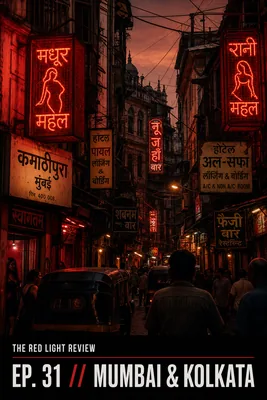
It is nine o'clock on a Tuesday evening in the summer of 2024, and Kamathipura's 14th Lane is not what it used to be.
A decade ago, the lane would have been luminous with coloured bulbs strung between the Colonial-era chawl buildings, women in synthetic saris leaning from iron-barred windows and shouting down prices to the men below, pimps in white kurtas operating from low plastic chairs at the lane mouth, the whole tableau accompanied by Bollywood music from somebody's phone. Tonight, most of the windows are dark.
Police sealed these brothels six weeks ago, and the women who remain have been told to cook only by mobile-phone torchlight so they cannot be seen from the street.
Three thousand kilometres east, the mood on Sonagachi's main lane — the one that spills off Beadon Street and into a tangle of sub-lanes behind the old mosque — is different. At nine in the evening this district still hums. The multi-storey brothels are lit on every floor.
Peer educators from the Durbar Mahila Samanwaya Committee move through the lanes distributing condom packets and handing out printed cards with the DMSC helpline number. A sex worker named Gita Das, 39 years old and in the trade since she was 16, walks past the touts without flinching. "I am a sex worker," she told Al Jazeera in 2015.
Two cities. Two of the world's largest commercial sex districts. One collapsing under the weight of real estate speculation and redevelopment pressure; one functioning with a level of self-governance that global public health organisations cite as a model for HIV reduction.
Both rooted in the same colonial administrative logic — the managed concentration of women into designated lanes — and both now navigating the strange legal ground of 21st-century India, where the Supreme Court confirmed in May 2022 that "sex work is a profession" while Parliament has still never decriminalised it.
The red-light districts of Mumbai and Kolkata are not accidents of urban drift. They are colonial infrastructure, planned and maintained by the same Victorian bureaucracy that built the railways, the port wharves, and the cantonment walls.
The British East India Company's administration formalised the regulation of prostitution in its Indian territories from the early nineteenth century, but the key legislative moment came in 1864.
The Cantonment Act (XXII of 1864) was passed in direct response to the Royal Commission into the Sanitary State of the Army of India, which had documented alarming rates of venereal disease among British soldiers. The solution was not abstinence. It was regulation.
Women who served soldiers in and around military cantonments were required to register, submit to fortnightly medical examinations, and be detained in a "lock hospital" if found infected with syphilis or gonorrhoea.
The logic of the lock hospital was simultaneously medical and spatial: concentrate the women, survey their bodies, contain the disease. The same logic would eventually generate the numbered-lane grids of Kamathipura and the multi-storey brothel blocks of Sonagachi.
Both were, in the literal nineteenth-century British colonial sense, "tolerated zones" — zones where regulated vice was preferred to unmanaged vice, where surveillance was easier, and where the state could at least pretend to administer public health.
The Contagious Diseases Acts that had been applied to British garrison towns were adapted for Indian cities. In 1888, the Indian Contagious Diseases Act was formally withdrawn — under pressure from feminist anti-regulation campaigns in Britain, led by Josephine Butler — but a revised Cantonment Act (XIII of 1889) immediately replaced it, retaining compulsory inspection under new wording.





Comments