
Madrid & Barcelona — Club Paradise, Highway Clubs, Spain's Industry
Club Paradise, highway clubs, and Spain's grey-zone industry
This episode hasn't been released yet. Subscribe to be notified when it drops.
I. EPISODE HOOK — Friday Night on the Autovía
It is 21:30 on a Thursday in late October. The A-4 motorway south of Madrid is dark except for the yellow sweep of headlights, the occasional orange glow of a service area, and something else — clusters of coloured light, blue-red-purple, pulsing against the Spanish plain like a fairground that has wandered off the map.
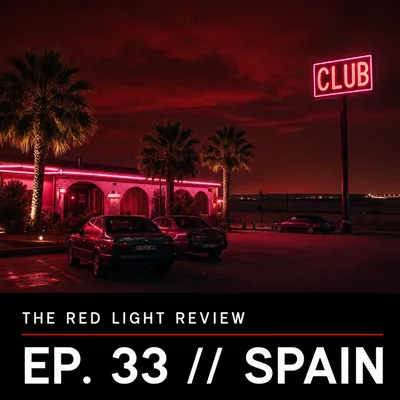
You take the carril de desaceleración, the deceleration lane, at a sign for hostelería, and swing into a gravel car park three times the size of the building it serves. The building is low, stuccoed white, with blacked-out windows and a pink neon marquee that reads a single word — a girl's name, or a place-name, or a cocktail, it barely matters.
A bouncer in a bomber jacket nods you through. Inside: cigarette smoke, Spanish pop at moderate volume, a bar selling San Miguel at €4 a bottle, and women — twelve, fifteen, twenty of them — in heels and lingerie, sitting at tables, moving between the bar and the curtained rear corridor that leads to the rooms.
This is the club de alterne. The puticlub. The local de alterne. The roadside brothel. And across Spain there are — by the most conservative police estimates — at least 1,500 of them, and possibly many more.
They squat along every major radial motorway out of Madrid: the A-1 toward Burgos, the A-2 toward Zaragoza, the A-4 toward Córdoba, the A-42 toward Toledo, the N-II toward the French border at La Jonquera. They are registered as hotels. They pay municipal rates as restaurants.
And for thirty years — since the Penal Code revision of 1995 created the legal vacuum they inhabit — they have operated in plain sight, advertising on giant roadside billboards, maintaining websites with photo galleries of their "chicas," and generating revenues that Spanish judicial proceedings suggest run to hundreds of millions of euros annually, most of it undeclared.
Simultaneously, thirty kilometres north-northeast, the Calle Montera descends from the Gran Vía toward the Puerta del Sol — a pedestrianised street that carries 7,000 foot-passengers per hour at peak times — and where, in clusters of two and three, women in short skirts negotiate with men who slow to a crawl then walk on. A police commissariat sits on the very same street.
The negotiations are technically legal. The women are, on the whole, Colombian, Dominican, or Nigerian. Some are there because they choose to be. Many are not.
Spain is the third-largest consumer of paid sex in the world, behind only Thailand and Puerto Rico. 5 billion, but acknowledge the sector's systematic invisibility makes precision impossible.
What is not in dispute: an estimated 300,000 women are selling sex across Spain at any given time, 80 percent of them migrants, and the National Police estimates more than 80 percent are victims of trafficking or exploitation.
Into this contradiction — between the self-image of a progressive European democracy and the reality of an unregulated mass sex trade operating openly on its motorways — the Red Light Review plunges for Episode 33.





Comments