
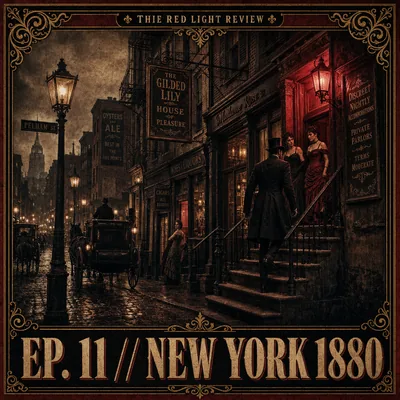
New York City I — Tenderloin, Five Points, the 19th Century Brothel Boom
Tenderloin, Five Points, and the gilded-age brothel boom
This episode hasn't been released yet. Subscribe to be notified when it drops.
It is a Tuesday evening in the autumn of 1870. A young clerk from a counting house on Nassau Street, newly arrived from Ohio, steps out of his boardinghouse on West 25th Street. He has with him a slim, pocket-sized booklet — fifty-five pages, no author listed on the cover — that he purchased for a few cents at a Broadway tobacconist. The title: The Gentleman's Directory: A Vest Pocket Guide to Brothels in 19th-Century New York for Gentlemen on the Go.
He does not need to walk far. The booklet in his hand lists 150 establishments within a mile. Starting right here, on West 25th Street, it recommends the Hotel De Wood at No. " The price for their company is not printed — but everyone who buys the directory already knows: a parlor house of this caliber charges $5 to $10 for an evening.
Further down the block: six more brothels, each occupying a matching brownstone. Seven sisters from a New England village, one by one recruited, now occupy what reformers call Sisters' Row. On Christmas Eve, their profits are given to charity. Engraved invitations go out to the best families.
Half a mile north, the Metropolitan Opera House is rising. Half a mile south, the Waldorf-Astoria is planned. In between: 23rd Street to 42nd Street, Fifth Avenue to Seventh Avenue — the district Captain Alexander "Clubber" Williams of the NYPD will famously name, in 1876, "the Tenderloin." He has been eating chuck steak on a policeman's salary, he says. Now he is going to have tenderloin.
This is the story of how New York City became, by 1870, what one contemporary scholar calls "the carnal showcase of the Western World."
In 19th-century New York, there was no single law explicitly criminalizing the act of prostitution itself. The physical exchange of sex for money was not universally codified as a crime in most American states until the 1920s. " This legal ambiguity was not accidental.
It was the mechanism by which Tammany Hall, the Democratic Party political machine that ran New York City government for much of the century, extracted revenue from the sex trade without formally endorsing it. Madams paid "fines" that were really structured payments. Police captains ran protection rackets. Ward bosses adjudicated disputes.
The machine made the industry possible; the industry funded the machine.
This system produced a paradox visible to every foreign visitor: a city simultaneously gripped by evangelical Protestant reform fervor and operating the largest concentration of commercial brothels in the Western Hemisphere.
Manhattan's sex trade was never static. It moved north with money.
The New York story of the 19th century is the template for every subsequent American red-light district debate: the tension between a politically connected vice economy and religious/civic reform; the role of immigration and female poverty in supplying workers; the use of moral panic (the "White Slavery" panic of 1910) as a legislative lever; and the way Progressive Era reforms did not eliminate commercial sex but simply drove it underground, where it became more dangerous for workers and more profitable for organized crime.
Understanding the Tenderloin explains Prohibition-era brothels, explains the Times Square of the 1970s, and explains the digital displacement of visible street markets in the 21st century.



Comments