
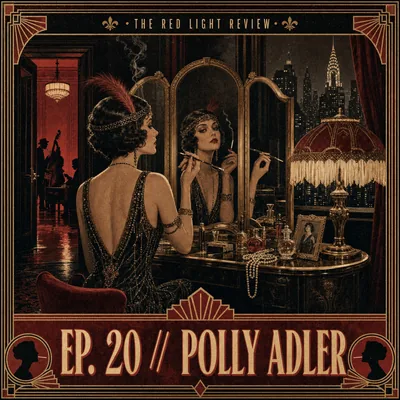
Polly Adler — NYC's Jazz Age Madam, 'A House Is Not A Home'
NYC's Jazz Age madam and 'A House Is Not A Home'
This episode hasn't been released yet. Subscribe to be notified when it drops.
It is the morning of March 5, 1935, and by the time the paddy wagon rolls up to 30 East 55th Street — one of Midtown Manhattan's most fashionable addresses — Polly Adler has already been arrested more than a dozen times. She knows the drill. She knows these cops. Some of them were at her place last week.
But this raid is different. Mayor Fiorello LaGuardia has been in office barely fourteen months, and he is not Jimmy Walker — he doesn't hold court at brothels, doesn't float through life on charm and speakeasy gin. LaGuardia is a reformer with a sledgehammer, literally: he has already been photographed smashing confiscated slot machines on the front steps of City Hall.
The pressure from his administration has been building for months. District Attorney William Dodge wants answers. The papers have been running Polly Adler's name for years, the way they run the names of star athletes.
The police move fast through the elegant twelve-room apartment. Persian carpets, Louis XVI chairs, a library wall stocked with books that Dorothy Parker and Robert Benchley chose for her. They arrest four women — Polly and three of her girls — on charges of maintaining a disorderly house and possessing an obscene motion picture.
Polly exits the building in a full-length mink coat, turns her face into the collar, curses at the photographers. The New York Daily News gets the shot anyway: the most famous madam in America, fifty-four arrests short of a conviction.
This time, it will stick. Not with much — she pleads guilty to the lesser charge and serves twenty-four days of a thirty-day sentence in the Women's House of Detention on Greenwich Avenue, scrubbing floors alongside aging prostitutes for whom the system has no mercy.
But the raid crystallizes something about Polly Adler's particular American story: a Jewish immigrant girl from a Belarusian shtetl, who arrived at Ellis Island alone at thirteen years old with her possessions in a potato sack, and who became, over two decades of relentless ambition, the most powerful woman in New York's criminal underworld — a woman known to Lucky Luciano, celebrated by Robert Benchley, avoided by Judge Samuel Seabury, and remembered long after most of her famous clients were forgotten.
On January 17, 1920, the Eighteenth Amendment to the Constitution took effect, banning the manufacture, sale, and transportation of intoxicating liquors in the United States. The result was catastrophic to the government's intention and miraculous to anyone in the vice trade.
The 10,343 licensed bars in New York City in 1919 were replaced by more than fifteen thousand speakeasies by 1920. The law had not eliminated the desire to drink; it had handed organized crime a monopoly on fulfilling it.
The bootlegger became a civic institution. Arnold Rothstein, the criminal financier who likely fixed the 1919 World Series, tutored Lucky Luciano and Meyer Lansky in the economics of Prohibition. Dutch Schultz ran beer in the Bronx. Legs Diamond moved whiskey on the East Side.
These men were not the grim figures of the previous century's vice trade — they wore bespoke suits, dined at El Morocco, tipped extravagantly, and brought their clients to places like Polly's.
The Jazz Age was not just a cultural flourishing. It was an ideological one. For the first time, middle-class Americans were openly flouting laws they considered puritanical. " If you were drinking illegally, you might as well be doing everything else. The moral architecture of the previous century had caved in overnight.




Comments