
Buenos Aires — Tango's Brothel Origins, the Zwi Migdal Trafficking Ring
Tango's brothel origins and the Zwi Migdal trafficking ring
This episode hasn't been released yet. Subscribe to be notified when it drops.
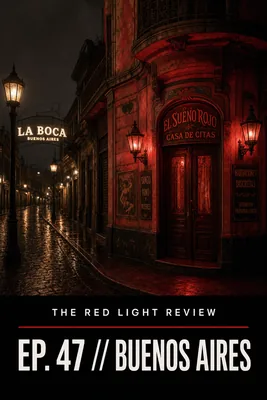
The casa de tolerancia at the corner of Almirante Brown and Necochea in La Boca district occupied two rented floors of a peeling stucco building, its shuttered windows hung with translucent pink curtains — the municipal code's prescribed signal, neither lantern nor sign, that the Buenos Aires city government required of licensed houses so they could be identified without giving offense to street-level modesty.
2 million, swollen by a decade of mass immigration that had deposited men from Galicia, Campania, the Levant, and the pale towns of the Russian Pale into the city's working-class arrabales at a rate that left them outnumbering women by something close to three to one.
Inside, the ground floor served a dual function that was typical of the smaller registered houses: a narrow parlor where men paid the regenta — the female house-manager required by ordinance — three pesos for an hour of company, and four separate rooms behind a curtained corridor.
A piano sat in the parlor, often silent; on busier nights a guitarist would be summoned from the conventillo tenement across the alley. The music he played was not the polished salon tango that Paris would soon make fashionable.
It was rawer — duple-time, African-influenced, insistent — what the musicians of the Guardia Vieja era had been playing in the port warehouses and courtyard dances of the barrio sur since the 1890s. The words, when there were words, were not the lachrymose verse about betrayal and exile that the Golden Age would later codify. They were comic, filthy, or both.
El choclo (the corn cob) and El fierrazo (the big rod) were not names that required translation.
" — a common enough anonymization in a system designed more to extract license fees than to name individuals.
She was required under the 1888 Reglamentarismo amendments to maintain a registration ledger, present her women for biweekly medical examination at the Dispensario de Salubridad, pay the annual patent fee of 10,000 pesos moneda corriente per establishment plus 100 pesos per registered worker, and ensure no woman under eighteen was in the house.
In practice, the biweekly examinations were erratically enforced, the health fees were a mechanism for bribing inspectors, and the minimum age was routinely ignored.
The city's registered prostitute count in the first year full statistics were available — 1889 — was 2,007 new enrollments; by 1910, with the city's population at its peak Edwardian growth, the Dispensario was processing twice that figure annually.
What made La Boca distinctive was its particular texture: a working waterfront neighborhood originally settled by Genoese sailors and laborers, with conventillos packed so tightly that twelve families shared a single courtyard, and where, by 1910, a young man from the Italian province of Foggia and a Jewish carpenter from Łódź might share a rooming house wall.
The music that moved between these overcrowded buildings and the registered houses down the block was already acquiring a specific character — a sound and a set of dance gestures that, within a decade, would become the defining cultural export of the Argentine republic. For now, in La Boca in 1910, it was simply what you heard while waiting.
On 5 January 1875, the Buenos Aires municipal council (Concejo Deliberante de la Capital Federal) issued the regulatory ordinance that would govern commercial sex in the city for the next six decades. The ordinance legalized prostitution within a formal system of licensed houses, drawing explicitly on French réglementarisme — the Parisian model that sought to confine an inevitable social ill to supervised, medically monitored establishments.






Comments