
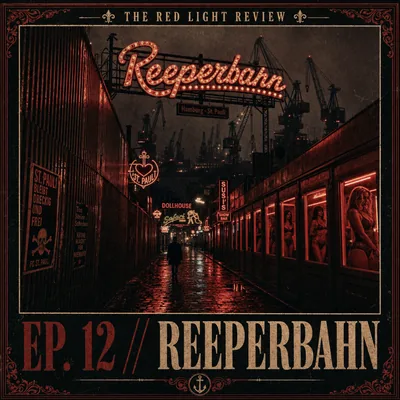
Hamburg — Reeperbahn, the Herbertstraße Wall, German Legalization
Reeperbahn, the Herbertstraße wall, and German legalization
This episode hasn't been released yet. Subscribe to be notified when it drops.
It is August 17, 1960. Five young men from Liverpool, still calling themselves the Silver Beatles, drag their guitars through a side street off the Hamburg waterfront as neon signs flicker on above them in the late evening dusk.
They are looking for a strip club on a street called the Große Freiheit — Great Freedom — where a man named Bruno Koschmider has promised them wages of thirty Deutschmarks a day to play rock and roll for sailors, dockworkers, and the women who work the windows just around the corner. The club is closed when they arrive. They sleep in the red-leather seats. Later, they will move into a windowless storeroom behind the Bambi Kino cinema, next to the women's toilets.
Paul McCartney would later remember it plainly: "We lived backstage in the Bambi Kino, next to the toilets, and you could always smell them. The room had been an old storeroom, and there were just concrete walls and nothing else. No heat, no wallpaper, not a lick of paint; and two sets of bunk beds — Union Jack flags for covers.
They will play up to eight hours a night, six and seven nights a week, in a city their parents consider the enemy, in a neighborhood that the city of Hamburg considers ungovernable. That neighborhood is St. Pauli. The street is the Reeperbahn — the Ropewalk — 930 meters of neon-lit clubs, strip bars, peep shows, and, running perpendicular to it behind twelve-foot steel walls at each end, the most famous prostitution street in Europe: Herbertstraße.
The Beatles left in December 1962. The women behind the windows are still there.
St. Pauli is a district in the western portion of central Hamburg, a city of 1.8 million in northern Germany, home to one of Europe's great ports. The district sits between the central railway station (Hauptbahnhof) and the Elbe river docks. It runs roughly east-west and is organized around a single arterial street: the Reeperbahn.
The Reeperbahn — whose name derives from Reep (Low German for "rope") and Bahn (track), meaning a place where ropes were manufactured by hand — is exactly 930 meters long. Wikipedia It runs east-west and is lined along its length with restaurants, music clubs, discotheques, strip bars, sex shops, and brothels.
Three side streets define the sexual geography of St. Pauli:
Große Freiheit (Great Freedom) runs north from the Reeperbahn and takes its name from an anomaly of 17th-century religious law: Catholics were permitted to worship here when the surrounding Protestant city of Hamburg banned the practice. In the 1960s it was the street of live music clubs — the Indra at number 64, the Kaiserkeller at number 36, the Star-Club at number 39. Today it remains an entertainment street; the Indra still operates as a club.
Davidstraße runs south from the Reeperbahn toward the Elbe. Street prostitution is legally tolerated here during regulated daytime and evening hours.
Herbertstraße is a narrow alley, approximately 150 meters long, running parallel to Davidstraße and accessible only through narrow S-shaped passages in its two steel barrier walls. It is the subject of most of this episode.
At the corner of Reeperbahn and Davidstraße stands the Davidwache, a red-brick police station built by architect Fritz Schumacher between 1913 and 1914 that is simultaneously the smallest police precinct in Europe (covering roughly one square kilometer and 14,000 residents) and the most famous police station in Germany.
com It has been featured in over a dozen major German television series and films since the 1960s. Paul McCartney and Pete Best spent a night in its cells in November 1960.



Comments