
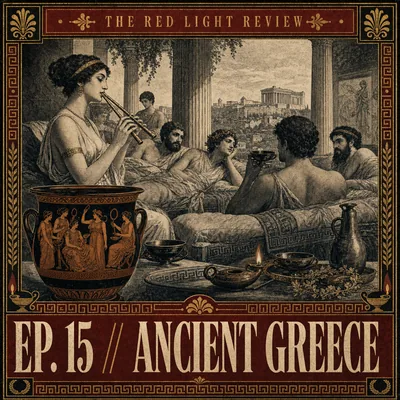
Ancient Greece — Pornai, Hetairai, Aspasia of Miletus
Pornai, hetairai, and Aspasia of Miletus
This episode hasn't been released yet. Subscribe to be notified when it drops.
It is 594 BCE, and Athens is in the grip of a crisis that no one quite knows how to name. Debt bondage has carved the citizen population into creditors and serfs. The agora buzzes with the kind of low-level rage that precedes political collapse.
Into this moment steps Solon — poet, traveller, lawgiver, the man the Athenians have essentially begged to fix everything — and among his many reforms, several of which will define Western political thought for the next two and a half millennia, he does something that nobody talks about in the textbooks: he establishes a dikteria, a state-regulated brothel, staffed with purchased foreign women, priced at one obol per visit.
One obol. The cost of a single loaf of bread. In a city that would eventually produce the Parthenon, Sophocles, and Socrates, the oldest and most durable piece of legislation governing female bodies was a pricing schedule.
" His solution — purchase foreign women, house them "in various quarters, equipped and common to all" — solved the problem of access. "The door is open," Philemon has a brothel-dweller announce. "One obol. " (Philemon, Brothers, fr.
Three centuries later, Athenians would be paying Phryne of Thespiae the equivalent of a year's skilled labour for a single night. The distance between those two prices — one obol to a hundred minas — is the social history of ancient Greek sex work. That is what this episode is about.
Classical Athens was not a single society but a stack of overlapping categories, each carrying different rights, obligations, and legal status.
At its base was the polis — the citizen-state — whose male members (Athenian-born, of Athenian parents on both sides after Pericles' 451 BCE citizenship law) held the franchise: the right to attend the Assembly, to vote, to hold office, to own land in Attica, and to marry a citizen woman.
Everyone else — metics (resident aliens), slaves, and freed slaves — occupied subordinate positions that the law kept carefully distinguished.
Women occupied a structurally peculiar position. Athenian-born women of citizen fathers were gynaikes (citizen women, the singular is gynē) — but they were citizens in a purely genealogical sense, not a political one. They could not vote, attend the Assembly, represent themselves in court, or conduct significant financial transactions without a male guardian (kyrios).
45) — defined the ideal of Athenian femininity. In practice, poorer women worked in markets and workshops; the seclusion ideology applied most strictly to the wealthy citizen household.
Sparta operated by different rules. Spartan women could own and inherit land, managed estates during their husbands' prolonged absences at barracks and campaign, educated their daughters alongside sons, and participated in athletic training.
Aristotle, discomfited by this, complained that "the Spartans made a mistake giving their women rights" (Politics 1269b12), attributing Sparta's fourth-century political decline to effective gynocracy.
Corinth, as a trading port-city on the Isthmus, was a third model: its prosperity rested on maritime commerce, and its reputation for the finest and most expensive hetairai in Greece became a pan-Hellenic cultural fact.




Comments