
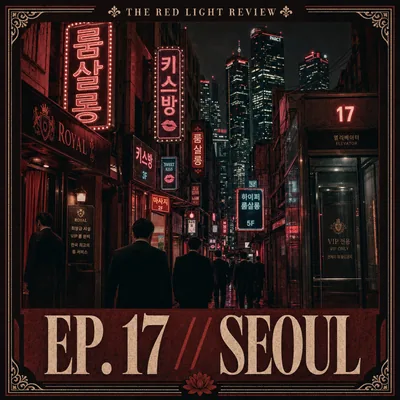
Seoul — Kiss Bangs, Room Salons, and the 10% Culture
Kiss bangs, room salons, the 10% culture, the juicy bar scandal
This episode hasn't been released yet. Subscribe to be notified when it drops.
m. " Around him, a private room roughly the size of a studio apartment fills with the clink of Chivas Regal poured over ice by a woman who has not yet told him her real name. A second woman is arranging a fruit plate. A third is linking her phone to a Bluetooth speaker. The bill—before anything escalates—is already approaching 1,500,000 won, roughly $1,100. The company will absorb it. It usually does.
This is a 룸살롱, a room salon, one of an estimated several thousand operating on any given night across Seoul, and particularly concentrated in the neon-lit corridors of Gangnam, Cheongdam-dong, and the leisure districts near COEX.
The practice is so normalized in South Korean corporate life that the National Tax Service, in 2024, documented that South Korean firms charged nearly 600 billion won—approximately $431 million—to corporate credit cards at adult entertainment venues in a single year, with more than half, some 328 billion won, spent specifically at room salons.
Across the city, in venues far less glossy, a different economy is running in parallel. In a converted officetel in Mapo-gu, a Telegram username is advertising what is described as a "massage and companionship" service; the rate for a call-out to a nearby motel is 200,000 won, and there is no illusion about the nature of the service.
In a basement corridor near Wangsimni, a 키스방—a kiss bang—is open for business at 40,000 won per thirty minutes, a price set with the precision of a parking garage fee structure.
In 2018, the last brothel in 청량리 588, or Cheongnyangni 588, Seoul's most famous red-light district, closed its shutters. Bulldozers arrived the following year. By 2022, the area was unrecognizable—replaced by the towers of Lotte Castle SKY-L65. The oldest surviving prostitution district in the South Korean capital had been erased. But the demand it once served had not gone anywhere. It had simply gotten better at hiding.
South Korea's regulatory relationship with commercial sex has been characterized, for most of the last century, by a paradox: the state simultaneously prohibited prostitution, tolerated it as an economic safety valve, and—during the critical decades of authoritarian-led development—actively managed it as a foreign-currency mechanism.
The foundation of the modern legal framework is the Act on the Punishment of Acts of Arranging Sexual Traffic, commonly called the Special Act on Sex Trafficking and Prostitution (성매매알선 등 행위의 처벌에 관한 법률), enacted in September 2004.
The law criminalized buying sex, selling sex, and facilitating either—an aggressive departure from the prior regime, which had technically prohibited prostitution since 1961 but enforced the law almost never.
Alongside it came a companion statute: the Act on the Prevention of Sexual Traffic and Protection of Victims (성매매방지 및 피해자보호 등에 관한 법률), which provided welfare services for those classified as victims.
The catalyst for the 2004 reform was not primarily moral panic but a series of fires. Between 2000 and 2002, blazes at brothel complexes in Gunsan—poorly ventilated, illegally constructed, locked from the outside—killed at least 14 sex workers who could not escape.
The fires exposed conditions that public officials had chosen not to see: women held in debt bondage, working in fire-trap buildings tolerated by local police who received regular payoffs. Women's rights organizations used the public horror to push a legislative agenda that had been stalled for years.
Comments