
Ancient Mesopotamia — Temple Priestesses and the Sacred Prostitution Debate
Temple priestesses and the sacred-prostitution debate
This episode hasn't been released yet. Subscribe to be notified when it drops.
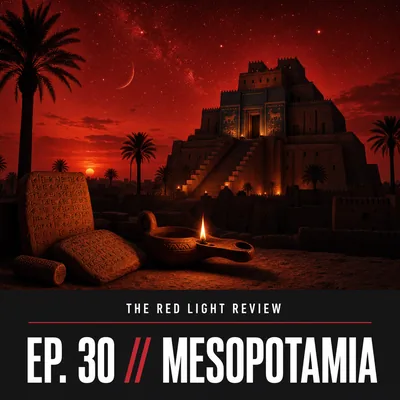
Picture it: the city of Uruk, southern Mesopotamia, sometime around 1750 BCE. The ziggurat of the Eanna — the "House of Heaven" — catches the last copper light of a Babylonian sunset. In the precinct below, the smell of barley beer drifts from open doorways. Wool-dyed awnings hang over the market stalls of the lower city.
Temple scribes press cuneiform signs into wet clay at the rate of a thousand tablets a day: cattle counts, grain allocations, lawsuits over inheritance, marriage contracts, debt notations. Every transaction legible. Every person accountable to an institution — temple, palace, or family household.
Moving through the precinct is a woman the tablets call a šamḫātu — a woman who is beautiful, sexually available, and not under the authority of any father or husband. She is neither slave nor nun. She is neither a sacred vessel for divine power nor a criminal.
She lives outside the patriarchal household economy that structures everyone else's life, and the city knows her by sight. In another part of the city, a woman the scribes label a nadītu lives in the gagûm — the walled cloister attached to the temple — managing her silver loans, leasing out agricultural land, and conducting the cult rituals of the god Šamaš.
She has not borne children. She has a husband, technically, but he has taken a second wife for that purpose.
These two women will never be confused with each other by anyone living in Uruk. They will, however, be catastrophically confused by every European scholar who reads about them for the next two thousand years.
This episode is the story of that confusion — and of what the cuneiform tablets actually say.
To understand any of what follows, you need to understand the world these women inhabited. Mesopotamia — the Greek rendering of the Akkadian māt nārim, "land between the rivers" — is the roughly 1,000-kilometre corridor of the Tigris and Euphrates river systems that today comprises modern Iraq and parts of Syria and Turkey.
From roughly 3500 BCE to 539 BCE, this corridor was home to the first literate urban civilization on earth, successively organized under Sumerian city-states, the Akkadian Empire, the Third Dynasty of Ur, the Old Babylonian period under Hammurabi, the Kassite period, the Middle and Neo-Assyrian empires, and finally the Neo-Babylonian empire.
The organizing unit of this civilization was not the nation-state. It was the city, and within the city, the temple. In the Ur III period (c.
2112–2004 BCE), temple estates at major cities like Girsu and Umma controlled thousands of hectares of agricultural land, employed tens of thousands of dependent laborers paid in monthly grain rations, and maintained industrial-scale textile workshops staffed almost entirely by women.
The temple was simultaneously the house of the god, the city granary, the lending institution, the employer of last resort, and the administrative center. The god owned everything in theory; in practice, the temple's administrators — priests, priestesses, accountants — ran an economy of staggering complexity.
The city-state system began to consolidate under Sargon of Akkad (r. c. 2334–2279 BCE), who created the first Semitic empire in the Near East, fusing Sumerian religious and administrative traditions with Akkadian language and culture. His daughter Enheduanna was installed as high priestess (en-priestess) of the moon god Nanna at Ur — and she is history's first named author, composing liturgical hymns to Inanna that survive on clay tablets to this day.
The period most relevant to this episode is the Old Babylonian period (c. 2004–1595 BCE), when Hammurabi of Babylon (r. 1792–1750 BCE) created the most famous legal text in pre-classical history and when the documents about nadītu women are most abundant. Shortly after Hammurabi's empire, the region fragmented again.



Comments