
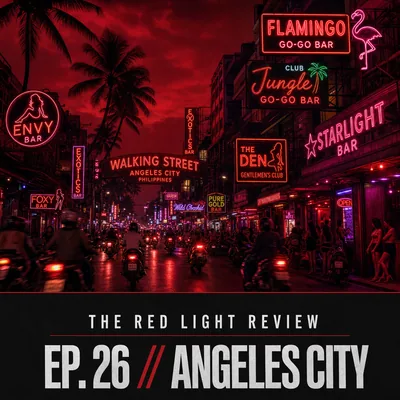
Manila & Angeles City — Bar Fines, US Military Legacy, Fields Avenue
Bar fines, the US military legacy, and Fields Avenue
This episode hasn't been released yet. Subscribe to be notified when it drops.
It is eleven o'clock on a Tuesday night in Balibago, and the air smells of exhaust fumes, frangipani from a hotel lobby, and fried pork fat from a streetside cart. The jeepney that dropped you at the corner of MacArthur Highway has already disappeared back toward Manila, two and a half hours south, and now you are standing at the mouth of what, for the better part of six decades, has been called Walking Street.
The strip is roughly three hundred meters long. m. m. in 2010, when the barangay's tourism board rebranded the pedestrian block in conscious imitation of Pattaya's famous entertainment corridor in Thailand. Several of the Australian and British bar owners who made the pitch had, in fact, previously operated bars on that Thai walking street.
They imported the concept wholesale: the neon facades, the raised stages visible through open doorways, the women in matching uniforms standing beneath hand-painted signs. By 2025 the city had attempted yet another rebrand — to "RED Street" — only to quietly abandon the experiment. The locals and the regulars kept calling it Walking Street. Or Fields Avenue.
Whatever you called it, you knew where it was.
m. the street is not yet at peak density. That won't come until after midnight, when the city's hundred-plus go-go bars have been open long enough for their stages to fill and their customers to grow generous. But the signs of the machine are already in motion.
In the illuminated doorway of Club Atlantis, a three-story structure that dominates the upper end of Walking Street, a floor hostess in a silver uniform beckons from a raised platform. Next door, the Dollhouse — sister bar to Atlantis under the same corporate ownership group — is louder, its music visible through the walls as a bass vibration you feel in your molars.
A Korean man in his early forties, part of what appears to be an organized golf tour from Incheon, consults with a mamasan — a senior female supervisor — who communicates prices and availabilities in rehearsed Korean-language patter.
Further down the strip, at Champagne and at Voodoo (the only bar on the street that never closes, operating 24 hours), the pattern repeats with variations. Lady drinks — small cocktails for which a customer pays ₱250 to ₱400, of which the woman drinking earns a ₱100 to ₱150 commission — are being ordered in quantity. The transaction is framed by the industry as entertainment.
The endpoint, for most customers and most workers, is understood to be something else.
What you are watching is not an accident. It is the end product of more than a century of military history, economic dislocation, deliberate tourism policy, legislative evasion, and the studied indifference of a succession of local governments.
It is the story of what happens when a superpower leaves, an economy collapses, a volcano erupts, and the only reliable foreign exchange left in town is generated by selling access to the bodies of women who have traveled from the poorest provinces in the archipelago to work in establishments that the city officially classifies as entertainment venues, employing workers who are officially classified as Guest Relations Officers, participating in a system that is officially not prostitution.
The story of Angeles City's sex industry begins not with the bars but with the horses. In 1902, the United States Army studied relocating its post from the town proper to a fertile plain in Barrio Sapang Bato, where the grass was better suited for cavalry.
A year later, President Theodore Roosevelt signed the executive order establishing what would become Fort Stotsenburg, the nucleus of what eventually grew into Clark Air Base — at its peak, the largest American military installation outside the continental United States.

Comments