
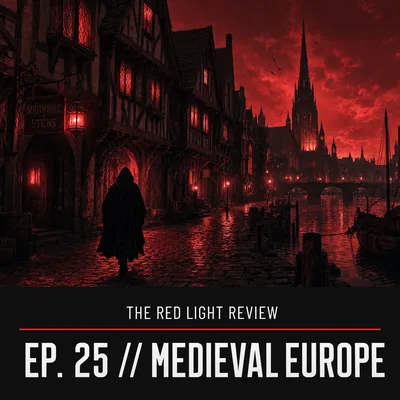
Medieval Europe — Church-Licensed Brothels, the Stews of London, Sumptuary Laws
Church-licensed brothels, the stews of London, and sumptuary laws
This episode hasn't been released yet. Subscribe to be notified when it drops.
The clerk arrives every Friday morning. He carries a leather satchel and a ledger, his episcopal seal pressed into the wax on the outside. He crosses the Thames from Lambeth by wherry, steps onto the south bank near the Bishop's Stairs, and begins his rounds. It is the autumn of 1390, and Bankside is at its busiest — the smell of river mud and tallow candles, the sounds of women calling from upper windows, the creak of wooden signs painted with swans and bells and cardinal's hats swinging above the doors.
His job is rent collection. He is an agent of the Bishop of Winchester, Lord of the Liberty of the Clink, and what he collects each week goes directly into episcopal accounts that also fund alms hospitals, parish churches, and eventually the renovation of Winchester Cathedral.
The women who pay him are known throughout London as Winchester Geese — a knowing joke, since geese were common slang for a woman who sold sex. The Geese belong, technically and legally, to no one. They are licensed, not owned.
But the debt structures, the weekly rents, the six-shilling-and-eightpence ceiling on loans from the stewholders, and the threat of the Clink prison just up the road mean that freedom, for most of them, is theoretical.
The clerk notes the names in his ledger: Joan, Margery, Agnes, Katerina. Each has paid fourteen pence for the use of her chamber this week. Those who have not paid will hear from the bailiff before nightfall.
This is the business. Not love, not sin, not romance — business, audited quarterly, managed by episcopal ordinance, taxed by the Crown, and debated by Parliament. Welcome to the medieval sex trade: regulated, franchised, and as close to a civic utility as the Middle Ages ever produced.
Medieval Europe was not a unified legal territory. It was a mosaic of jurisdictions — cities with their own charters, liberties exempt from county law, ecclesiastical estates beyond the reach of civil magistrates, merchant republics answering to their own councils, and rural manors whose lord was effectively the last word on everything that happened within sight of his tower.
This fragmentation matters enormously for understanding how commercial sex was regulated, because regulation did not come from the top down. It came from wherever power happened to pool: a bishop, a city council, a duke, a guild.
When Augustine of Hippo wrote in the fourth century that removing prostitution from human affairs would "unsettle everything because of lusts," he was not endorsing it — he was making a political-theological argument about the management of fallen human nature. The passage, from De Ordine, became one of the foundational texts of medieval sexual politics.
Thomas Aquinas refined it in the thirteenth century with the famous comparison: prostitution in a city is like a sewer in a palace — take away the sewer, and the palace fills with filth. What neither Augustine nor Aquinas actually advocated was profiting from that sewer.
But what they produced, philosophically, was the "necessary evil" doctrine — the idea that tolerating a minor sin could prevent greater ones, principally rape, sodomy, and the corruption of "honest" women.
City fathers across Europe invoked this doctrine with striking consistency for four centuries. They did not merely tolerate prostitution. They municipalized it — brought it inside the administrative machinery of civic government, subjected it to licensing, rents, health inspections, and dress codes, and then quietly pocketed the revenue. The Church did the same.
The gap between official theology and actual practice was the most profitable real estate in medieval Europe.
Medieval Europe's population roughly doubled between 1100 and 1300, and urban populations grew faster still.




Comments