
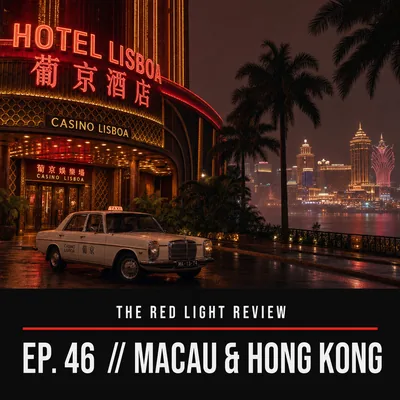
Macau & Hong Kong — Saunas, Fishball Girls, Mainland Clientele
Saunas, the 'fishball' girls, and mainland clientele
This episode hasn't been released yet. Subscribe to be notified when it drops.
It is a Friday evening in Macau, the hour when the light off the Pearl River Estuary turns the sky above the Cotai Strip the colour of a spent chip. At the Eighteen Sauna on the sixth floor of the Golden Dragon Hotel, Rua de Malaca, a man in a business suit receives a laminated card listing services with prices denominated in Hong Kong dollars. The cheapest entry — a steam bath, unlimited soft drinks, a thigh massage — runs HK$800 or so.
" Full packages at the upmarket Rio Sauna on the fifth floor of the Rio Hotel — two rounds of what the house menu calls "pecker priming," two foot massages, and one session of full-service sex — bill out at roughly HK$3,650, or about US$470, according to contemporaneous reviews from 2013 to 2015. At Família Nobre, the standalone establishment off the Lisboa circuit, a multi-service package came out to the equivalent of US$348 in the same period.
On busy weekend nights the premises fill past capacity, and management hands waiting customers numbered locker keys and directs them to an open buffet.
Eight kilometres and a forty-minute ferry ride away, in Mongkok, Kowloon, the calculus is more brutal. In the tower blocks that line the upper reaches of Portland Street and Sham Shui Po, handwritten signs outside narrow lobby entrances advertise women by nationality and a brief list of services.
In 2012, a half-hour with a local Cantonese woman cost approximately HK$250; with a Thai or mainland Chinese worker, HK$180 to HK$300; a "Russian" (in practice, often Kazakh or Uzbek) woman commanded HK$500 for thirty minutes.
These are the yat lau yat fung — the one-woman flats, literally "one floor, one phoenix" — the most legally visible form of sex work in Hong Kong, permitted by a loophole so long-standing it has effectively become official tolerance.
Neither city has a red-light district in any formal sense.
What they have instead is an intricate ecology of law and evasion, demand and supply, that has been building since the Portuguese left Macau and the British left Hong Kong, sustained by the world's largest gambling revenue, the biggest single flow of internal Chinese migration, and a geography that makes three of the most profitable commercial sex markets on earth accessible within a single day's journey from Guangzhou.
Hong Kong's approach to sex work is not decriminalisation and it is not criminalisation. It is something stranger: a legal structure that makes the act itself lawful while criminalising virtually every activity that surrounds it. This arrangement is not accidental; it is the sediment of colonial legislation layered over more than a century.
The governing statute is the Crimes Ordinance, Cap. 200. Under Section 117(1), "prostitute" is defined as a person of either sex who offers the body commonly for lewdness in return for payment — and crucially, sexual intercourse is not required. The act of selling sex, conducted privately, carries no criminal penalty. What is illegal are the architecture around it:
The operative mechanism created by Section 139 is the one-woman flat. If two women are found working in the same premises, it is an illegal brothel. If only one woman works there, it is not a vice establishment under the law.
The result, documented across Mongkok, Sham Shui Po, Jordan, and parts of Wanchai, is a cityscape of small apartments in which individual women conduct business independently, each unit separated from the next by a door and a staircase.



Comments