
Bali & Jakarta — Spas, Blok M, the Dolly Red-Light District Closure
Spas, Blok M, and the closure of Dolly
This episode hasn't been released yet. Subscribe to be notified when it drops.
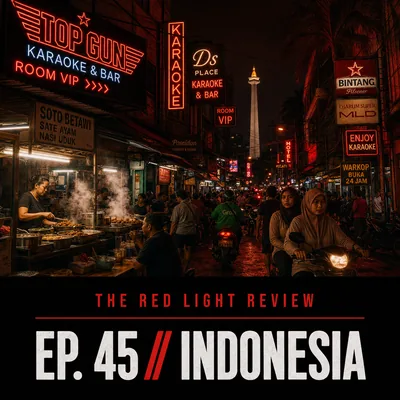
m. on a Friday in South Jakarta, and Jalan Falatehan — the narrow side street the expat circuit long ago nicknamed something unprintable — is doing its slow, familiar business. The signage is modest: a hand-painted bar name, a neon Bintang beer logo sweating in the equatorial air, a doorman in a polo shirt who nods tourists past without ceremony.
Inside D's Place and Top Gun, which have occupied the same two-storey shophouses since the 1990s, the clientele is a mix that would not exist anywhere else on Earth — retired Australian contractors, Korean tour company reps, a clutch of British teachers from the international school belt, and a table of Indonesian men in batik shirts who look at the foreign faces with the practiced indifference of people who have seen this before.
The women working the room are almost entirely Indonesian, mostly in their twenties, dressed in tight jeans and blouses rather than anything theatrical. They are freelancers in the strict local sense: no pimp, no room fee pre-paid, no bar-fine system like Bangkok's. The negotiation, if it happens, happens directly.
Prices in these establishments in 2024 run from Rp 300,000 to Rp 600,000 for short time — somewhere between twenty and forty US dollars — though the girls at Top Gun, which skews older clientele and has a reputation for asking high, will open at Rp 500,000 and not move much.
The neighborhood has contracted sharply from its 1990s peak. The Hotel Melawai's sixth-floor massage operation — long known by the expat code "5+1" for the multiple-woman arrangement it offered at roughly fifty dollars per person — has been closed for years. m.
but by midnight the streets look merely like any secondary entertainment strip in a large Southeast Asian city, rather than a district organized, as it was a generation ago, around commercial sex as its primary industry.
Twelve kilometers to the north, in the old Mangga Besar district of West Jakarta, a different Friday is unfolding. The spa and karaoke corridors of Jalan Mangga Besar VIII fill with men arriving by motorcycle taxi and private car.
" A 90-minute session at a standard room runs Rp 110,000–130,000; the additional services, negotiated in the room, are priced separately and differently at each venue, with full-service transactions in the Rp 350,000–500,000 range common. Nobody in Mangga Besar is calling this a red-light district.
The Indonesian government's term for the old formal brothel complexes — lokalisasi, or "localization" — implies a contained, mapped geography. What exists here is something murkier: a shadow economy of plausible-deniability venues dispersed through a city of thirty-four million people.
This is the world that Indonesia's 2022 Penal Code — in force since January 2, 2026 — was designed, in part, to confront. Whether it will succeed, or merely replicate the displacement and public-health damage of every closure campaign before it, is the question this episode pursues.
Indonesia is the world's largest Muslim-majority nation, with roughly 231 million Muslims among a population of 277 million, and it governs its sexual economy through a framework that is simultaneously colonial in origin, regionally fragmented, and now, for the first time since independence, formally prohibitionist at the national level.
The old KUHP. The criminal code Indonesia inherited from Dutch colonialism — the Kitab Undang-Undang Hukum Pidana, or KUHP — never explicitly criminalized the act of selling sex. What it punished were the surrounding behaviors.

Comments