
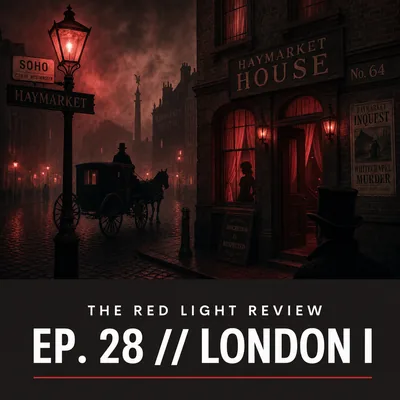
London I — Soho's History, Walk-Ups, the Maltese Gangs
Soho's history, walk-ups, and the Maltese gangs
This episode hasn't been released yet. Subscribe to be notified when it drops.
The gas-jets along the Haymarket have been burning since dusk, and by one o'clock in the morning the pavement outside the Windmill Street end is barely navigable. A French traveller named Hippolyte Taine, who will later set this scene in print, pushes through a current of silk and serge, of cheap scent and cheaper gin, of feathered bonnets bobbing at eye level in every direction. He counts, in a single hundred-yard stretch, twenty women who approach him directly.
Some ask for a glass of gin. " He writes that he seemed to be "watching a march past of dead women.
At this hour, Kate Hamilton's "nighthouse" on Panton Street, just off the Haymarket, is in its prime. The doorman admits only those likely to spend the modern equivalent of £450 in a single sitting.
Inside, beneath chandeliers fitted with the newest gas-mantles, women in trained gowns circulate among members of Parliament, officers of the Household Cavalry, and City speculators. Champagne — called "fizz" by the women who drink it — flows from the bar counters. The orchestra plays waltzes.
When police raid the premises two years later, in 1862, they will find fifty-five women on the premises, all of them there for a single professionally understood purpose.
Step outside into the cold fog of the Haymarket and you are in the physical centre of what the Victorians will call "the Great Social Evil" — a city within the city, operating entirely in plain sight, with its own geography, its own economy calibrated to the penny and the shilling, its own celebrity figures, its own literary record, and its own catastrophic human cost. This is the London we are going to walk tonight.
London in the first half of the nineteenth century was undergoing the most violent demographic transformation in its history.
The population of the metropolitan area swelled from roughly 959,000 in 1801 to 2,685,000 by 1851 — a near tripling in fifty years, driven by the collapse of rural employment, the enclosure of common land, and the gravitational pull of manufacturing and trade.
The city absorbed workers from every county in England, from Ireland (especially after the Famine of 1845–1852), and from the continent. Most arrived with nothing.
The labour options available to working-class women were brutally narrow.
Domestic service absorbed the largest single cohort — by 1851 there were roughly 905,000 domestic servants in England and Wales, overwhelmingly female — but terms were at an employer's absolute discretion, and a dismissal without a character reference (which could be withheld for the most capricious reasons, including a master's unwanted sexual advances) was effectively a sentence to destitution.
Needlework, millinery, and the garment trades paid starvation wages: a seamstress in 1843 could earn two shillings and three pence for a fourteen-hour day producing shirts, barely enough to pay lodging in a common doss-house at fourpence a night.
Henry Mayhew, whose monumental London Labour and the London Poor appeared in instalments from 1851 and in collected volumes in 1861 and 1862, was among the first investigators to frame the economics plainly: "The greatest cause of prostitution," he wrote, "is the low rate of wages that the female industrial classes receive, in return for the most arduous and wearisome of labour.
" When needlework paid two shillings for twelve hours and a client on the Haymarket paid two shillings for ten minutes, the arithmetic required no further commentary.






Comments