
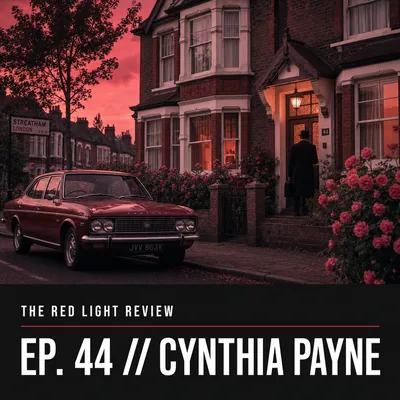
Cynthia Payne — Streatham's Madam Cyn and the Luncheon-Voucher Brothel
Streatham's 'Madam Cyn' and the luncheon-voucher brothel
This episode hasn't been released yet. Subscribe to be notified when it drops.
It was a Wednesday afternoon, three weeks before Christmas, and the queue on the staircase at 32 Ambleside Avenue in suburban Streatham was moving in the orderly fashion one associates with a well-run establishment. The men waiting were, in the main, elderly. They wore suits. Several had arrived by Rover. A few wore trilby hats. One had a briefcase. They were not rowdy. They were not drunk. They were patient, comfortable, and quite clear about why they were there — each of them clutching a small paper slip in denominations of 10p and 15p.
m. on Wednesday, 6 December 1978, Metropolitan Police officers executed a search warrant on the property. The warrant cited the suspected illicit sale of alcohol.
What officers found inside the five-bedroom Edwardian house — its net curtains undisturbed, its garden freshly trimmed by devoted unpaid hands — was something the warrant had not anticipated and that the British press would spend the next forty years describing with a mixture of delight, incredulity, and occasional hypocrisy.
There were 53 men and 13 women present. The men were in varying states of undress; some wore lingerie and corsetry; others waited in ordinary business attire on the stairs and in the hallway. The police had been transfixed, on entering, by the sight of a naked Black woman descending the staircase as a queue of men ascended it. " On the stove, something was keeping warm.
The small paper slips the men were clutching were luncheon vouchers — those tax-subsidised tokens that British employers issued to their workers so that they might afford a proper midday meal. At 32 Ambleside Avenue, they had been repurposed.
An entrance fee of £25 secured access to a pornographic film, a live show, food and drink, and the services of one woman of the guest's choice. Each woman performing services was issued a luncheon voucher as an internal receipt, redeemable later with the house's proprietor as proof of transaction and the basis for payment.
The proprietor was a 45-year-old woman named Cynthia Payne.
Within hours, the story was on the front page of every newspaper in Britain.
The queue of middle-aged and elderly gentlemen, the luncheon vouchers, the vicars, the solicitors, the peer of the realm, the Air Vice-Marshal — the whole tableau was so improbably, so perfectly, so inimitably English that it instantly became a kind of national mythology, the secular equivalent of a Benny Hill sketch performed by actual members of the establishment.
The Times, the Daily Mirror, the Sun, and every tabloid in Fleet Street ran the story for days. Time magazine in the United States devoted an essay to it, comparing the sentencing judge (acting months later) to the rascal beadle of King Lear — "Why dost thou lash that whore? " Cynthia Payne's name and address became, briefly, the most famous in Britain.
For the next four decades, they would never quite cease to be.
To understand what Cynthia Payne was charged with — and why the charge was so imprecise, so reliant on medieval common law, and ultimately so embarrassing — it is necessary to understand the peculiar architecture of mid-twentieth-century British legislation on sexual commerce.
The Sexual Offences Act 1956 consolidated and restated the Victorian and Edwardian statutes governing sexual conduct in England and Wales. It was, in the main, a codification exercise — the lawyers' version of a tidy home: all the mess moved into one drawer. Section 33 of the Act made it a criminal offence to keep a brothel, or to manage or assist in the management of one.


Comments