
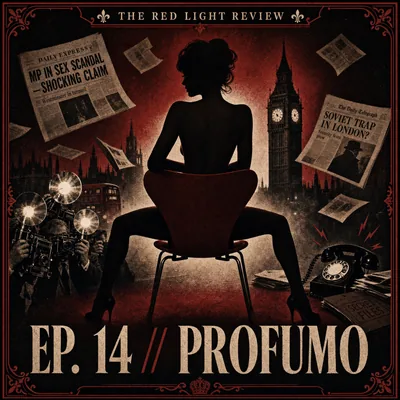
The Profumo Affair — Sex, Spies, and a Fallen Government
Sex, spies, and the scandal that shook Westminster
This episode hasn't been released yet. Subscribe to be notified when it drops.
It is a warm Saturday evening in July 1961, and the Thames Valley holds the day's heat long past sunset. At Cliveden House — a Palladian pile on a bluff above the river in Buckinghamshire, one of the grandest private estates in England — Lord William Astor is hosting the weekend's principal party inside. His guests are from the worlds of politics and the arts: important people, well-dressed, careful with their words.
In the guest list, buried among diplomats and society figures, is John Dennis Profumo, fifty-one years old, Secretary of State for War in Harold Macmillan's Conservative government, wearing his war record and his tailoring with equal ease. Beside him, his wife — Valerie Hobson, once one of Britain's most celebrated film actresses, now the devoted consort of a rising minister.
About a mile along the estate's grounds, at a cottage that Astor rents to his osteopath and occasional companion Stephen Ward, a smaller party is gathered around the Cliveden swimming pool. Ward has asked permission to use it after the main house has gone to dinner, and the request has been granted.
Among Ward's guests is Christine Keeler: nineteen years old, a showgirl from Murray's Cabaret Club in Soho, born in a converted railway carriage in Wraysbury, Berkshire, now living in Ward's Wimpole Mews flat in London. She goes into the pool without a swimsuit.
At approximately 10:30 p.m., Astor's party — dinner done — strolls down from the main house for an evening walk. The two groups meet at the pool's edge. Keeler scrambles for something to cover herself, finding a towel that is, by most accounts, too small for the purpose. Profumo — according to what he later told his son — found her "a very pretty girl and very sweet." He asked Ward for her telephone number before the evening was out.
Five shots fired into a door in Marylebone eighteen months later would begin the unravelling of everything.
The Britain of 1961 was simultaneously old and new in ways that made it peculiarly combustible. The welfare state and National Health Service were barely fifteen years old, still recent enough to feel like experiments. The last National Service conscripts had only just completed their service.
The empire was dissolving at speed — Ghana independent in 1957, Nigeria in 1960, Tanzania and Sierra Leone in 1961. The nuclear deterrent had passed from Lancaster bombers to the V-bombers, and arguments about whether Britain should be an independent nuclear power or depend entirely on American weapons were live and bitter.
" He was a patrician of the old school, educated at Eton and Balliol, a veteran of the trenches who had been wounded three times on the Western Front and who had married into the Cavendish family, the Dukes of Devonshire. His governing style was deliberately aristocratic: unflappable, ironical, seemingly impervious to pressure. He liked to be photographed reading Trollope.
Beneath this performance, he was acutely aware that his government was running out of road — not on a single policy failure but on the accumulated weight of seeming outdated in a country that was growing younger and louder and less deferential by the year.
The Establishment — the word was new then, coined by journalist Henry Fairlie in a 1955 Spectator essay to describe the interlocking network of class, schooling, professional connections, and social obligation that governed British public life — was the unseen architecture of power.
An Old Etonian could cross from the Foreign Office to the City to a government ministry without ever encountering anyone who had not been in the same house at school. Access to this network was the primary form of capital in British public life, and it was non-transferable.


Comments