
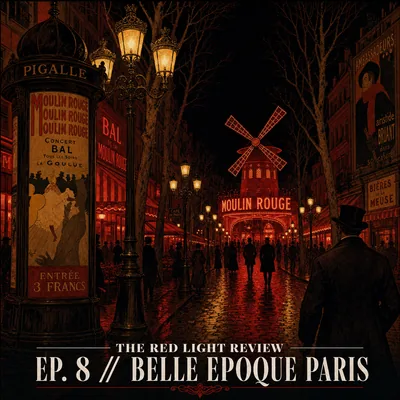
Belle Époque Paris — Maisons Closes, Le Chabanais, the Great Courtesans
Maisons closes, Le Chabanais, and the great courtesans
This episode hasn't been released yet. Subscribe to be notified when it drops.
The year is 1890. A royal personage — corpulent, cheerful, unmistakably English — arrives by private carriage at 12 rue Chabanais, a narrow street barely three blocks from the Louvre. " He visits perhaps a dozen times a year, always with advance notice, always settling into the suite that has been fitted with his coat of arms above the bed.
Tonight, his standing order is executed: the great copper bath — decorated with the head and torso of a woman, the lower half a swan — is filled not with water but with vintage Moët & Chandon. He steps in. Two women join him.
When the bath is done, he moves to a second piece of custom furniture: a brocade chair he calls the siège d'amour, fabricated specifically for him by Louis Soubrier, master cabinetmaker of the Rue du Faubourg Saint-Antoine. The chair is a stacked bunk of two reclining platforms, each equipped with bronze stirrups.
It exists because Bertie, who stands five meals a day and has a 48-inch waist, cannot comfortably perform the most ordinary acts of love without engineering assistance. The chair is designed to allow relations with two women simultaneously while distributing his considerable weight mechanically rather than anatomically.
This is Le Chabanais, the most prestigious maison close in Europe, and what happened inside it was, in its era, entirely legal, industrially organized, medically inspected by the Paris police prefecture, and — at the top tier — priced at sums that would represent years of a working woman's wages.
The Belle Époque was, among other things, the golden age of state-licensed prostitution. This is how it worked.
France did not invent legal prostitution, but it perfected the bureaucratic architecture around it. After the Revolution removed the legal prohibitions of the Ancien Régime, Napoleon's Consulate instituted, by decree in 1804, a system of réglementation — regulation — that would govern French commercial sex for the next 142 years.
The logic was sanitary and social rather than moral. Alexandre Parent-Duchâtelet, the towering figure of early French public health and a pioneer of what we would now call sociology, published De la Prostitution dans la ville de Paris in 1836, a two-volume work based on exhaustive statistical research.
" His central argument was that prostitution was a necessary égout — sewer — that, if properly channeled, protected respectable women and the social order. Left unregulated, it was a source of syphilis, disorder, and social chaos. Regulated, it could be contained, medically supervised, and tolerated.
The metaphor was hydraulic: vice as wastewater requiring engineering, not moral condemnation.
The system that emerged from Parent-Duchâtelet's analysis and the 1804 Napoleonic decrees operated on these principles:
Registration. Any woman wishing to work as a prostitute — or any woman apprehended by the police des moeurs (morality police) while soliciting — was required to register at the Prefecture of Police. Upon registration she received a card (carte) that gave her legal status as a fille inscrite (registered girl) or fille soumise (submitted girl).
The word soumise — literally "subjected" or "submitted" — was not incidental. Registered women submitted to state authority over their bodies and labor.
Medical inspection. Twice per month, every registered prostitute was required to submit to a physical examination — a pelvic inspection by a police-appointed physician — to screen for venereal disease.






Comments