
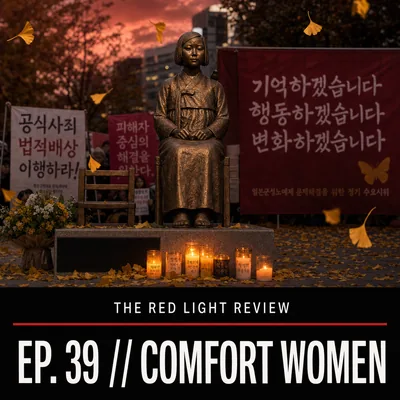
Comfort Women System (WWII) — Imperial Japan's Military Brothels
Imperial Japan's military comfort-women system
This episode hasn't been released yet. Subscribe to be notified when it drops.
The press conference convened in Tokyo on August 14, 1991, was small — a rented room, a handful of journalists, a woman who had turned sixty-seven the previous year and who carried sixty-seven years of a secret so corrosive she had once told no one, not even her children. Her name was Kim Hak-sun. She had been born in 1924 in Jilin, China, to Korean parents, and trained as a kisaeng — a traditional female entertainer — in Pyongyang.
On August 14, 1991, in front of cameras she had personally summoned, Kim Hak-sun said the words that would open a door that half a century of shame, social stigma, and official Japanese denial had held shut: "I am Hak-soon Kim, forcibly taken as a 'comfort woman' for the Japanese military." The date — the eve of Korea's Liberation Day — was not accidental. She understood exactly what she was doing and what it would cost her.
"I started sharing my story," she later explained, "because I had to say what I wanted to say before I died. I am almost 70 years old, and I am not afraid of anything. I will say what I have to say."
Within weeks, hundreds of other women — from Korea, China, Taiwan, the Philippines, Indonesia, and the Netherlands — began to come forward. The Japanese government, which had until that moment denied that any official coercion had ever taken place, found itself confronted with a wave of first-person testimony it could not contain.
Professor Yoshiaki Yoshimi of Chuo University, watching the coverage from Tokyo, went back to an archive he knew. What he found there would prove equally irreversible.
This is the story of ianfu — "comfort women" — the largest state-organized system of sexual slavery in the history of modern warfare. It is a story that was suppressed for fifty years, contested for thirty, and that remains, as of this writing, unresolved in the courts of international law and in the conscience of the nation that created it.
To understand the comfort women system, one must first understand the structure of Japanese colonialism in the early twentieth century. Japan annexed Korea in 1910 after establishing a protectorate in 1905.
For three and a half decades, Koreans were denied political representation, stripped of land, compelled to adopt Japanese names, and forbidden to teach in their own language.
The colonial economy was deliberately shaped to maintain Korean labor as a disposable resource for Japanese capital — which meant that poverty was structural, young women were economically desperate, and the mechanisms of state authority that might have protected them had been replaced by mechanisms of Japanese military and police control.
Japan had also developed, domestically, an extensive system of licensed prostitution (kōshō seido) that normalized the purchase and regulation of women's bodies. This infrastructure — legal, commercial, social — would be transposed, with modifications, onto the occupied territories.
When the Imperial Japanese Army's culture is examined with clear eyes, a grim logic emerges. Japanese soldiers were given almost no recreational leave, in contrast to Western military doctrine.
Three stated rationales recur in official Japanese military correspondence from the period:

Comments