
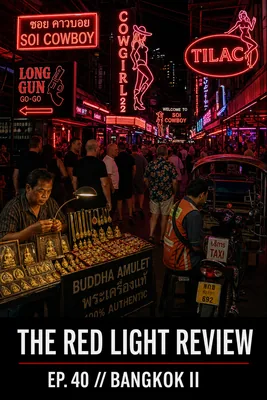
Bangkok II — Soapy Massage, Happy-Ending Parlors, Ladyboy Bars
Soapy massage, happy-ending parlors, and ladyboy bars
This episode hasn't been released yet. Subscribe to be notified when it drops.
Nine o'clock on a Tuesday, and Ratchadaphisek Road is already humming at a frequency that has nothing to do with traffic. The avenue — officially a mid-city arterial connecting Huai Khwang to Din Daeng — is lit in a particular way: not the screaming neon of Soi Cowboy, not the chaotic bazaar energy of Nana Plaza, but something more subdued, more deliberate. The signs are vertical. The facades are clean. The valets wear uniforms.
You pull up to the Poseidon Entertainment Complex at the junction of Ratchadaphisek and the lane that bears its unofficial neighborhood name. The building is enormous: five stories of pale concrete, a covered car park, a sign rendered in classical Greek lettering above the entrance.
In honor of the mighty Greek god Poseidon who ruled the waterworld, the company's own website reads, the complex began operation on Ratchadaphisek Road in 1999. Inside, on the second floor — the Venus Showcase — rows of young women sit behind a glass wall, numbered tags on their wrists, the lighting warm and deliberate, like a jewelry store that sells something else entirely.
This is aab ob nuat — the Thai soapy massage. And Poseidon, before the pandemic shuttered it, was one of the largest such establishments in Asia.
The fishbowl, as regulars call it, is the organizing principle of the soapy. A customer enters, browses the numbered lineup through the glass, selects a woman by her number, and is escorted to a private room.
What happens next — the shared shower, the foam-lathered air mattress, the body-to-body slide — is technically illegal under Thai law and widely understood by every party involved. The customer pays the house fee at the front desk. The personal arrangements are made in the room. The law looks the other way. It always has, for a price.
But the story of Bangkok's soaplands is not simply a story about sex.
It is a story about the architecture of tolerance: how a city manages an industry it has declared illegal, how the economy that flows through these marble lobbies feeds hospitals and universities and rural rice fields, and how the women and kathoeys who work in these places have organized, litigated, marched in high heels, and drafted legislation in the face of five decades of official denial.

Comments