
Prague & Eastern Europe — Czech Mega-Brothels, K5 Relax, Post-Soviet Markets
Czech mega-brothels, K5 Relax, and the post-Soviet sex economy
This episode hasn't been released yet. Subscribe to be notified when it drops.
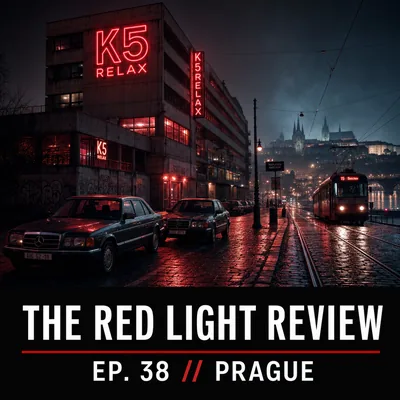
It is 10 p.m. on a Saturday in Vinohrady, one of Prague's most elegant residential neighborhoods. Tram No. 22 rattles past the neo-Gothic Church of Saint Ludmila, its lit windows throwing orange diamonds across the wet cobblestones of Náměstí Míru. Less than a hundred meters from the church's carved stone saints, at the corner of Korunní 5, a discreet red neon sign reads: K5 Relax.
There is no queue outside, no lurching bouncer with a velvet rope. The façade is designed to vanish into the residential streetscape — a brass plaque, an intercom, a tinted glass door.
Inside, a man in a suit checks identity documents before collecting the entry fee: 500 to 600 Czech korunas, approximately €20 to €25, or 2,400 korunas (roughly €99) for immediate access to the private rooms upstairs.
The marketing manager, in a 2005 interview with Prague Tribune, confirmed that over 90 percent of the clientele is foreign — Germans, Austrians, British stag parties, a sprinkling of French — and that the average customer spends around 5,000 CZK on a typical evening.
The interior opens into a strip-bar-style lounge: beach chairs under artificial light, a small stage, women in cocktail dresses circulating between tables or relaxing against the bar. On busy weekends, anywhere from 30 to 50 women are working the floor and the upstairs rooms simultaneously. Rates for a 30-minute session in a private room run from 2,400 to 3,500 CZK (roughly €100–€145). An hour ranges higher, contingent on extras negotiated privately.
" Under Czech law, this designation is deliberate — and defensible.
Because sex work itself is not illegal in the Czech Republic, but running a brothel formally is, establishments like K5 exist in the most profitable legal crack in Central European commercial regulation: acknowledged by city authorities, visited by foreign dignitaries and journalists, generating millions in annual revenue, and technically operating in a grey zone that has never been closed by a court.
" The Czech Interior Ministry was circulating draft bills for the fifth time in a decade. A La Strada social worker was conducting outreach on Wenceslas Square, less than four kilometers away. And in a converted market hall in Holešovice, the city's largest de facto brothel — ShowPark — was accommodating its 158,000th visitor of the year.
The Czech Republic's relationship with commercial sex is built on a legal paradox deliberately never resolved. Article 189 of the Czech Penal Code criminalizes procuring — inducing, hiring, or enticing a person into sex work, and profiting from another's sex work. Article 190 criminalizes offering sexual services near schools or places frequented by children.
The result: individual sex workers operate in a legal grey zone. Organized prostitution — pimping, trafficking, brothel-keeping in the traditional sense — is criminally prohibited. But what constitutes a "brothel"? This definitional vacuum has been the organizing fact of the Czech sex industry for three and a half decades.
The European Parliament's own research body, assessing Czech law in 2021, summarized it precisely: "Since 1990, prostitution in the Czech Republic is legal (no longer banned) but unregulated. Article 189 c.c. criminalises inducing, hiring or enticing a person into sex work, and profiting from others' sex work." What it cannot do, and does not do, is criminalize the buyer or the seller acting alone.



Comments