
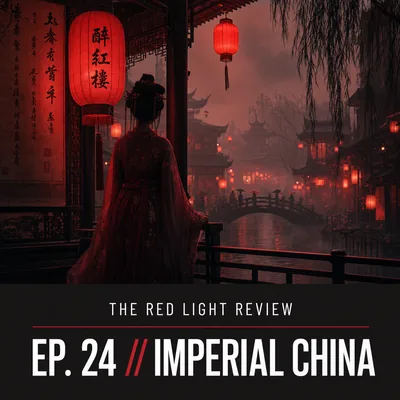
Imperial China — Courtesan Culture, Shanghai's Flower Houses
Courtesan culture and Shanghai's flower houses
This episode hasn't been released yet. Subscribe to be notified when it drops.
It is three in the afternoon on a Thursday in the autumn of 1910, and the Fuzhou Road district of Shanghai's International Settlement is just beginning to wake. The night workers do not stir before mid-afternoon. On the pavement below, a rickshaw puller idles beside a gas lamp that will not be lit for three more hours. Above him, on the second floor of one of the tall, tiled buildings known throughout Shanghai as 花妓馆 — huājìguǎn, "flower houses" — a young woman named Yulian is having her hair arranged by a maidservant not much younger than herself.
Yulian is a 长三 (chang-san), a first-tier courtesan, the aristocracy of the Shanghai sex trade. The name itself is an artifact of mahjong culture: a 长三 is a tile valued at three, and the term signals that a man wishing to spend an evening in Yulian's company would pay three yuan for her presence at a banquet table and three more for the privilege of staying until dawn.
Six yuan total — roughly equivalent to six weeks' wages for a cotton-mill operative working the same Shanghai streets twelve hours a day. Yulian does not work in a cotton mill. She will not stoop to eat until after dark.
She has lived in this flower house since the age of eleven, when her father, a bankrupt grain merchant from Jiangsu province, sold her indenture to the madam for twenty taels of silver. The madam kept meticulous ledgers.
By Yulian's eighteenth year, her debt — compounded by the cost of lessons in qin zither, erhu fiddle, classical poetry, the proper way to pour Shaoxing wine, the art of lighting an opium pipe, and the slow-burning education in how to make powerful men feel like emperors — had grown to more than one hundred and fifty taels. She would not clear it for another four years.
If a wealthy man — a comprador, a treaty-port lawyer, a Shanghainese banker — wished to buy her freedom outright and install her in his household as a concubine, he would need to negotiate with the madam for a sum that, in 1910, rarely fell below three hundred taels for a 长三 of her standing.
Downstairs, in the reception parlor that smells of incense and the sweet rot of jasmine arranged in porcelain vases, the madam is already receiving visitors: the owner of a textile concern, a French Concession police inspector who has a standing arrangement, a young Ningbo merchant eager to impress a business associate from Wuhan. They are playing cards.
They are not here for sex, not yet, not primarily. They are here because the flower houses of Fuzhou Road are, in the lexicon of treaty-port Shanghai, the unofficial stock exchange of masculine prestige. The 妓女 (jìnǚ, "prostitute") who attends a man in a flower house is less a commodity than a social credential.
In a city carved into foreign concessions and Chinese wards, where the rules changed depending on whose jurisdiction you happened to be standing in, the flower house was one of the few institutions that everybody — British inspector, Chinese merchant, Japanese trader, French bureaucrat — understood and respected.
Yulian finishes her hair. She descends the stairs. Her story is not unique. In the autumn of 1910, there are tens of thousands of women like her in Shanghai alone.





Comments