
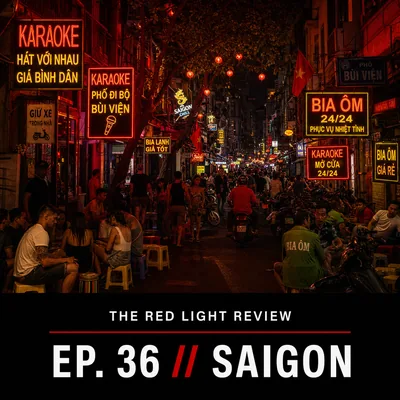
Ho Chi Minh City & Hanoi — Karaoke Ôm, Massage Parlors, Vietnam's Hidden Economy
Karaoke ôm, massage parlors, and Vietnam's hidden vice economy
This episode hasn't been released yet. Subscribe to be notified when it drops.
SECTION ONE: THE HOOK — 11 PM, A DISTRICT 1 ALLEY
The alley runs off Bùi Viện Street at approximately 11 PM on a Tuesday. Two stories up, neon-pink light bleeds through frosted glass. A laminated sign on the door reads Karaoke — Dịch Vụ Đặc Biệt (Special Services). A motorbike dispatcher sits on a plastic stool, scrolling his phone. He doesn't look up.
Inside, the layout is recognizable from a thousand similar rooms across Southeast Asia: a curved vinyl sofa, an oversized flat screen cycling through garish music-video backdrops, a microphone stand, a laminated song-request book in Vietnamese and, at the bottom of the menu list, a pricing sheet written in felt-tip pen. Room rate: ₫200,000 per hour. Beer: ₫45,000.
The tay vịn — literally "handrail girl," the hostess whose job is to ensure you never quite lose your balance — costs ₫500,000 extra for the session, payable at the door.
The cô gái tay vịn who enters is twenty-three or twenty-four. She wears a pink satin dress cut high on the thigh, carries a tray of Saigon Special beer, and sits not across from you but beside you, close enough for her arm to brush yours as she helps you select a song. The microphone will be passed. The beer will be poured. The tip negotiation — if it happens — will happen quietly, in the last quarter hour, in a voice below the music.
This is karaoke ôm, Saigon's most distinctive contribution to Southeast Asian vice geography, the institution that has survived French administration, American occupation, Communist liberation, and fourteen rounds of anti-prostitution ordinances. It is not technically a brothel. It is not technically legal. It is ubiquitous, institutionalized, and deeply woven into the political economy of a city of ten million people.
Ho Chi Minh City — officially renamed in 1976, still called Saigon by most of its residents, by the Vietnamese diaspora worldwide, and in all contexts that matter for this dossier — operates one of Southeast Asia's most elaborate hidden vice economies.
The People's Republic of Vietnam prohibits the buying and selling of sex under Ordinance 10/2003, enforces periodic crackdowns with theatrical competence, and has maintained for five decades the legal fiction that prostitution has been eradicated or at least managed.
Meanwhile, by the government's own admission, HCMC had 4,033 establishments identified as prone to prostitution in 2025, more than 12,000 workers employed across those venues, and an estimated 864 active sex workers even by the most conservative official count — a figure the same government acknowledges represents only the visible tip of a submerged industry.



Comments